General
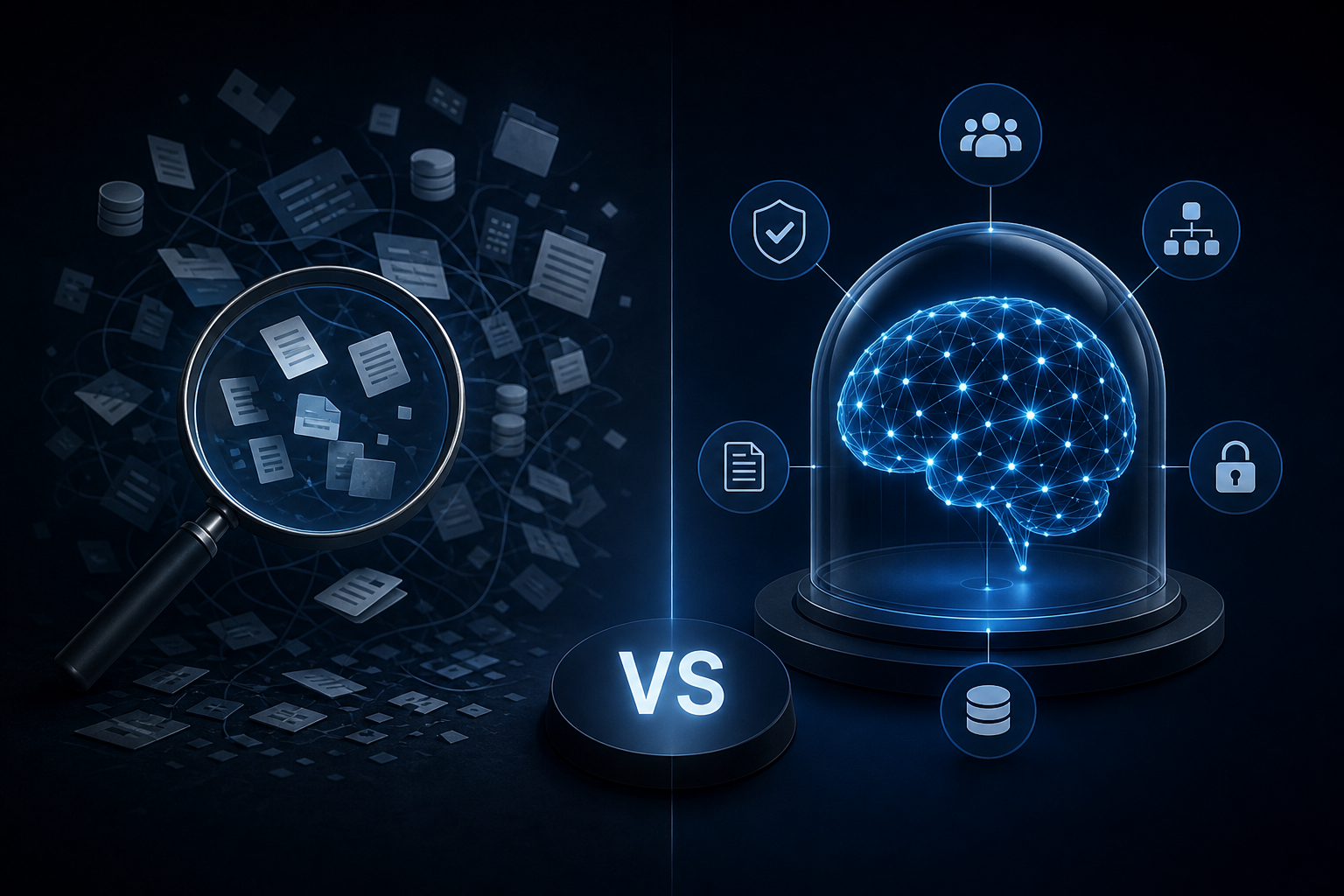
Enterprise AI Search vs. a Governed Company Brain: Key Differences
Discover how enterprise ai search differs from a governed company brain and which knowledge approach your team actually needs to act on trusted data.

Avoid ai vendor lock in with this guide covering contracts, architecture decisions, and ownership strategies for everything your agency builds.
AI vendor lock-in happens when your business becomes so dependent on a single provider's models, APIs, or data formats that switching is prohibitively expensive. For agency clients, the risk is doubled: you can be locked into both the underlying AI platform and the agency itself. The steps below show you how to prevent both.
Most business owners don't discover the problem until they try to leave. By then, the code is tangled around a proprietary API, the data lives in a format only one vendor reads, and the agency that built it holds the only copy of the methodology. Prevention is a contract conversation and an architecture decision. Remediation is a costly rebuild.
AI vendor lock-in occurs when the systems built for your business are so tightly coupled to one provider's infrastructure that moving to another option requires rebuilding from scratch. This is not a theoretical risk. According to a 2026 IBM-sourced report via getsaasbrief.com, 91% of executives admit they lack a full understanding of their organization's AI stack dependencies. If you don't know what you depend on, you can't protect yourself from it.
Lock-in operates at five distinct layers. Most agencies create exposure at all of them without flagging it.
Model layer. Your prompts, fine-tuning, and evaluation criteria are calibrated to one model's behavior. Swap the model and outputs change in ways you can't predict without re-testing everything.
Prompt layer. Prompts are often written for a specific model's formatting conventions. Research by Sclar and colleagues found that changing prompt formatting alone can shift a model's accuracy by up to 76 points. That's not a minor adjustment. That's a rebuild.
Data layer. Training data, embeddings, and retrieval indexes stored in a vendor's native format don't export cleanly. You lose the work, not just the platform.
API layer. Application code written directly against a single provider's API requires a rewrite every time that provider changes pricing, deprecates an endpoint, or gets acquired.
Infrastructure layer. Compute, storage, and orchestration tied to one cloud provider creates a second lock-in problem on top of the AI-specific one.
The agency layer compounds all of this. When an agency builds on a single provider and keeps the architecture inside their own systems, you inherit both dependencies at once. You're renting the output, not owning the system.
Switching sounds straightforward until you price it out. The work includes auditing every integration, rewriting API calls, re-embedding your data in the new provider's format, re-testing outputs against your quality bar, and retraining your team. None of that is fast, and none of it is cheap.
An IBM survey found that 71% of enterprises find it difficult to switch their primary AI vendor or model. Difficulty, in practice, means months of engineering time and a system that regresses in quality before it improves.
The cost categories apply at every scale: data migration, integration rewrites, staff retraining, and lost productivity during the transition window.
For smaller operations, the numbers are lower but the proportional pain is the same. Proprietary formatting makes clean export hard, and a fine-tuned model usually stays inside the provider that trained it, meaning that work is simply abandoned when you switch.
There's also a renewal problem. AI vendor lock-in often becomes visible at contract renewal, when agencies or providers issue quotes well above the previous year. At that point, you face a choice between an unbudgeted cost increase and a migration that costs more than staying. That's not a negotiation. That's a trap.
The pattern is consistent: the longer you wait to address lock-in, the more expensive it becomes to fix. The right time to solve this is before the first line of code is written.
Start by mapping every dependency in your current or planned AI setup before any agency begins building. You can't negotiate for what you haven't named.
A dependency audit covers five areas, one for each technical layer where lock-in occurs.
Model dependencies. List every AI model your systems call. Note whether those models are accessible through multiple providers or exclusive to one. If a model is only available through a single vendor's API, flag it.
API dependencies. Document every direct API call in your codebase or your agency's proposed architecture. Calls made directly to a provider's proprietary endpoint, rather than through an abstraction layer, are lock-in risks.
Prompt dependencies. Collect every prompt template your system uses. Identify which ones are written for a specific model's formatting conventions. These will need to be rewritten or re-tested if you ever change models.
Data dependencies. Identify where your training data, embeddings, and retrieval indexes live. If they exist only inside a vendor's managed service, you don't own them in any practical sense.
Infrastructure dependencies. Map your compute, storage, and orchestration. Note whether any of it is locked to a single cloud provider's proprietary services rather than portable open standards.
Run this audit before you sign with any agency, and ask the agency to complete the same exercise as part of their proposal. Any agency that can't answer these questions clearly is building something you don't fully own. Data from the UK Competition and Markets Authority indicates that fewer than 1% of cloud customers switch providers annually. The reason isn't satisfaction. It's that the switching cost, once dependencies are embedded, is too high to justify. The audit is how you keep that cost from accumulating in the first place.
The contract is your first real line of defense. Architecture decisions matter, but a well-built system can still leave you exposed if the agency retains the IP, controls the credentials, or never hands over the source code. Negotiate these terms explicitly before you sign anything.
IP ownership, assigned to you on day one. The contract must state that all code, prompts, workflows, and trained artifacts created during the engagement are your property from the moment they are produced. "License to use" language is not ownership. If the clause says the agency retains IP and grants you a license, push back or walk away.
Source code escrow or direct repository access. You should hold the repository, not the agency. If the agency insists on managing the codebase, require a source code escrow arrangement with a named third-party escrow provider and defined release triggers. A trigger should include agency insolvency, contract termination, and any failure to deliver a milestone.
Data export SLAs. Require a written commitment that all your data, including embeddings, fine-tuning datasets, retrieval indexes, and structured outputs, can be exported within a defined window (30 days is a reasonable ceiling) in a standard, non-proprietary format. Vague language like "data available upon request" is not a service level agreement.
Documented methodology and prompt library. Any prompt templates, evaluation criteria, or workflow logic the agency creates belong to you. The contract should require delivery of these artifacts, not just the running system.
Termination and transition assistance. Include a clause requiring the agency to provide a defined number of transition hours if the engagement ends, covering handover documentation, credential transfers, and onboarding support for your internal team or a replacement vendor.
If you want a framework for evaluating which agencies actually build to these standards before you negotiate, the AI agency comparison guide at singular-innovation.com/comparisons covers what to look for in ownership terms across different engagement models.
Good contracts protect you legally. Good architecture protects you technically. The two work together, and neither is sufficient on its own.
The core principle is decoupling: your application logic should never be written directly against a single provider's API. When it is, every model call is a hard dependency, and changing the provider means rewriting the application. The fix is an abstraction layer that sits between your code and the model endpoint.
An API abstraction layer works by routing all model calls through a single internal interface that your code talks to. That interface handles the translation to whichever provider sits behind it. Swap the provider, update the routing configuration, and your application code stays unchanged. This is standard practice in mature software engineering and is increasingly available as open-source tooling for AI specifically.
A model router extends this further. Rather than routing all calls to one provider, a router directs different task types to different models based on cost, latency, or capability. A high-stakes classification task might go to one model; a high-volume summarization task might go to a cheaper one. The application doesn't know or care which model handled the request.
The third safeguard is a portable evaluation set: a curated collection of inputs and expected outputs you use to test any model's performance on your specific tasks. It is independent of any vendor's benchmark. When you consider switching models or providers, you run your evaluation set against the candidate and measure the delta. Without it, you have no objective basis for comparison and no way to know whether a new model meets your quality bar.
Ask your agency to build the abstraction layer into the initial architecture, not as a retrofit. Retrofitting it later costs more and creates the same kind of migration risk you're trying to avoid. Data from the UK Competition and Markets Authority shows that fewer than 1% of cloud customers switch providers annually, and inertia is a large part of why. A decoupled architecture removes the technical inertia before it sets in.
Data portability is the most overlooked layer of lock-in, and it's often the most expensive to fix after the fact. Whatever you invested in fine-tuned models usually stays with the provider that hosts them, meaning that work is simply abandoned when you switch. The same applies to embeddings, retrieval indexes, and any structured knowledge your system has accumulated.
The rule is simple: your primary data lives in your accounts, in standard formats, from the start.
Training and fine-tuning data. Store all datasets as plain JSON, CSV, or JSONL files in a cloud storage account you control, such as AWS S3, Google Cloud Storage, or Azure Blob Storage. Never let the agency store primary datasets only inside a vendor-managed fine-tuning service.
Embeddings and vector indexes. If your system uses a vector database for retrieval, confirm that the underlying vectors can be exported in a standard format (Parquet or numpy arrays are common). Managed vector services that don't support export are a data trap.
Prompt libraries and evaluation sets. These are text files. They should live in your version-controlled repository, not in the agency's internal tooling or a provider's prompt management interface.
Workflow definitions and agent configurations. Any automation logic, agent instructions, or orchestration definitions should be stored as human-readable files (YAML or JSON) in your repository. If the workflow only exists inside a proprietary visual builder with no export, you don't own it in any portable sense.
Knowledge artifacts and context layers. If the agency builds a structured knowledge layer for your business, the underlying documents, schemas, and metadata belong in your own storage. The knowledge layer should be a governed, auto-updating system that runs inside your infrastructure, not a black box hosted in the agency's environment.
Audit these storage locations at the end of every project phase, not just at final delivery. By the time you discover data is trapped in a proprietary format, the agency may be off the project and the vendor may have changed its export terms.
Managing lock-in risk yourself is possible. It requires a thorough dependency audit, tight contract language, a decoupled architecture, and disciplined data hygiene across every project phase. If you have an ops lead or a technical co-founder who will stay on top of all four, that approach works.
If you don't, the alternative is to hire an agency that hands over full ownership structurally, so the risk never accumulates in the first place.
Singular Innovation is an AI agency that builds operating systems for businesses, consolidating scattered data sources, automating recurring workflows, and deploying AI agents inside the tools a company already uses. Every system ships with the client as the owner from day one: source code, prompt libraries, workflow definitions, and the governed knowledge layer called the Company Brain. There is no license arrangement, no methodology the agency retains, and no dependency on Singular's continued involvement to keep the system running.
Vendor lock-in in cloud computing occurs when your infrastructure, data, or application code is so tightly coupled to one provider's proprietary services that migrating to another requires a significant rebuild. In AI specifically, this includes model APIs, managed fine-tuning services, proprietary vector databases, and orchestration tools that don't export to standard formats. The cost is not just migration time. It's the accumulated work you lose when formats don't transfer.
Portability means your primary data lives in standard formats you control, model calls route through an abstraction layer rather than directly to a single provider's API, and all workflow logic sits in human-readable files inside your own repository. You can swap any component, including the AI model, the cloud provider, or the agency, without rebuilding the application. Portable evaluation sets let you verify that a replacement component meets your quality bar before you commit.
Yes, and you should do it before signing. IP ownership is a negotiable contract term, not a fixed policy. The contract should state that all code, prompts, trained artifacts, and workflow definitions are assigned to you at the moment they are produced. If an agency offers a license to use rather than full assignment, that is not ownership. Require direct repository access or a named source code escrow arrangement with defined release triggers, including agency insolvency and contract termination.
Run the five-layer audit described in Step 1. If your application code calls a single provider's API directly with no abstraction layer, you're locked in at the API layer. If your embeddings or fine-tuning data exist only inside a vendor-managed service with no export option, you're locked in at the data layer. If your prompts are calibrated to one model's formatting conventions and have never been tested on another, you're locked in at the prompt layer. Finding one of these is common. Finding all five means migration is expensive.
It reduces model-layer lock-in but doesn't eliminate the other four layers. An open-source model you can run on your own infrastructure removes dependence on a single provider's API pricing and availability. But if your application code is still written directly against one hosting provider's interface, if your data lives in a proprietary store, or if your prompts are calibrated to that specific model's quirks, you still have lock-in at those layers. Open-source models are one part of a portable architecture, not a complete solution on their own.
AI vendor lock-in is a structural problem, not a technical accident. It builds up layer by layer: model dependencies, API calls written against a single endpoint, data stored in formats only one vendor reads, and IP that stays with the agency when the engagement ends. By the time it becomes visible, the cost to fix it is higher than the cost to have prevented it.
The practical path forward starts with the dependency audit in Step 1, before any agency starts building. Then negotiate the contract terms in Step 2, confirm the architecture follows the decoupling principles in Step 3, and verify your data storage against the checklist in Step 4. If you want to skip the ongoing management overhead entirely, look for an agency whose engagement model assigns you full ownership from the first day of work. Start with the dependency audit in Step 1, work through the contract and architecture steps, and verify your data storage against the checklist in Step 4. Those four steps, done before any agency starts building, keep the cost of switching from accumulating in the first place.
Discover how enterprise ai search differs from a governed company brain and which knowledge approach your team actually needs to act on trusted data.
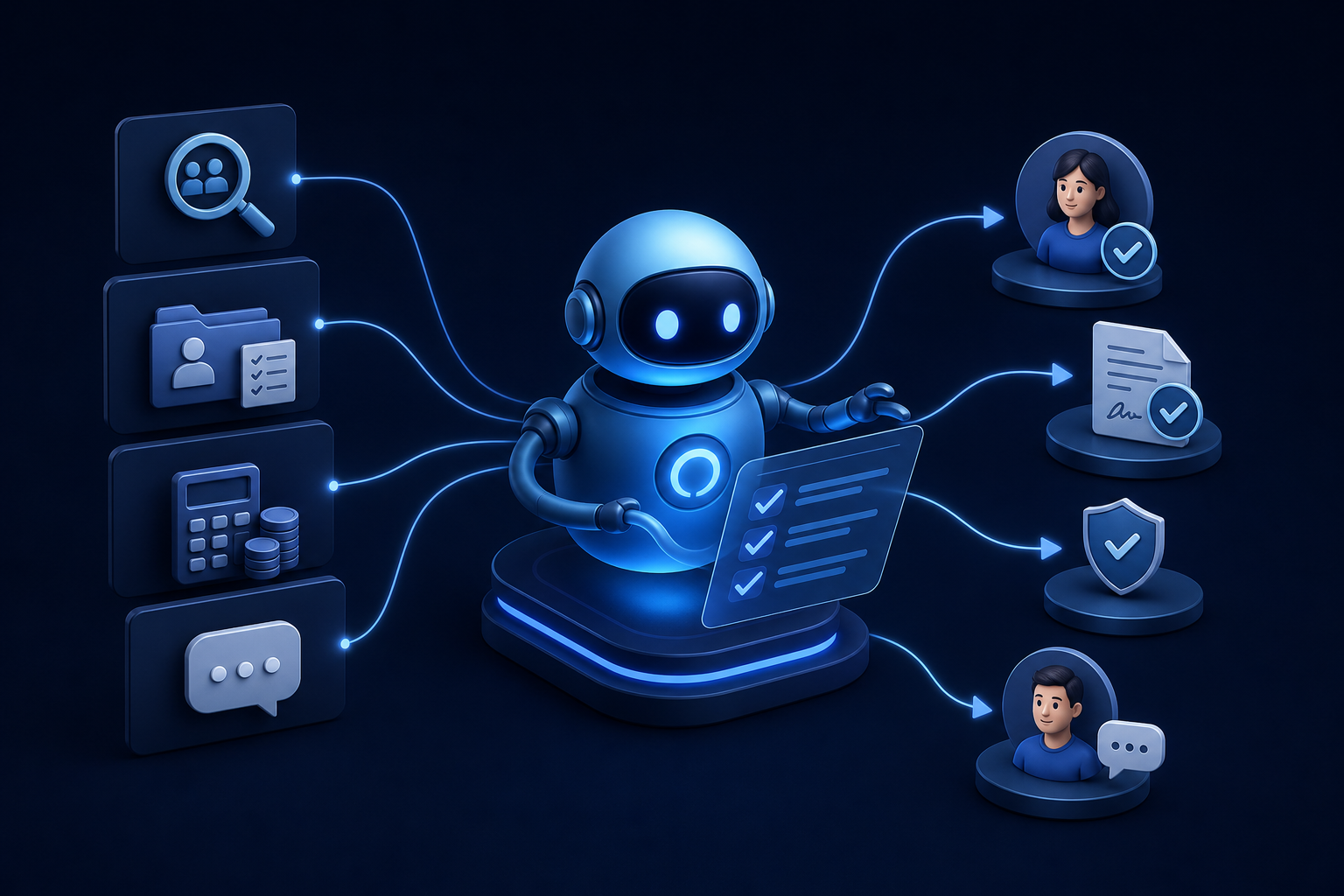
Discover how ai for hr automation handles recruiting, onboarding, payroll checks, and employee Q&A so your team can focus on work that matters.

Explore custom ai agent development paths: build in-house, buy pre-built, or partner with a specialist. Find the right fit for your team today.


