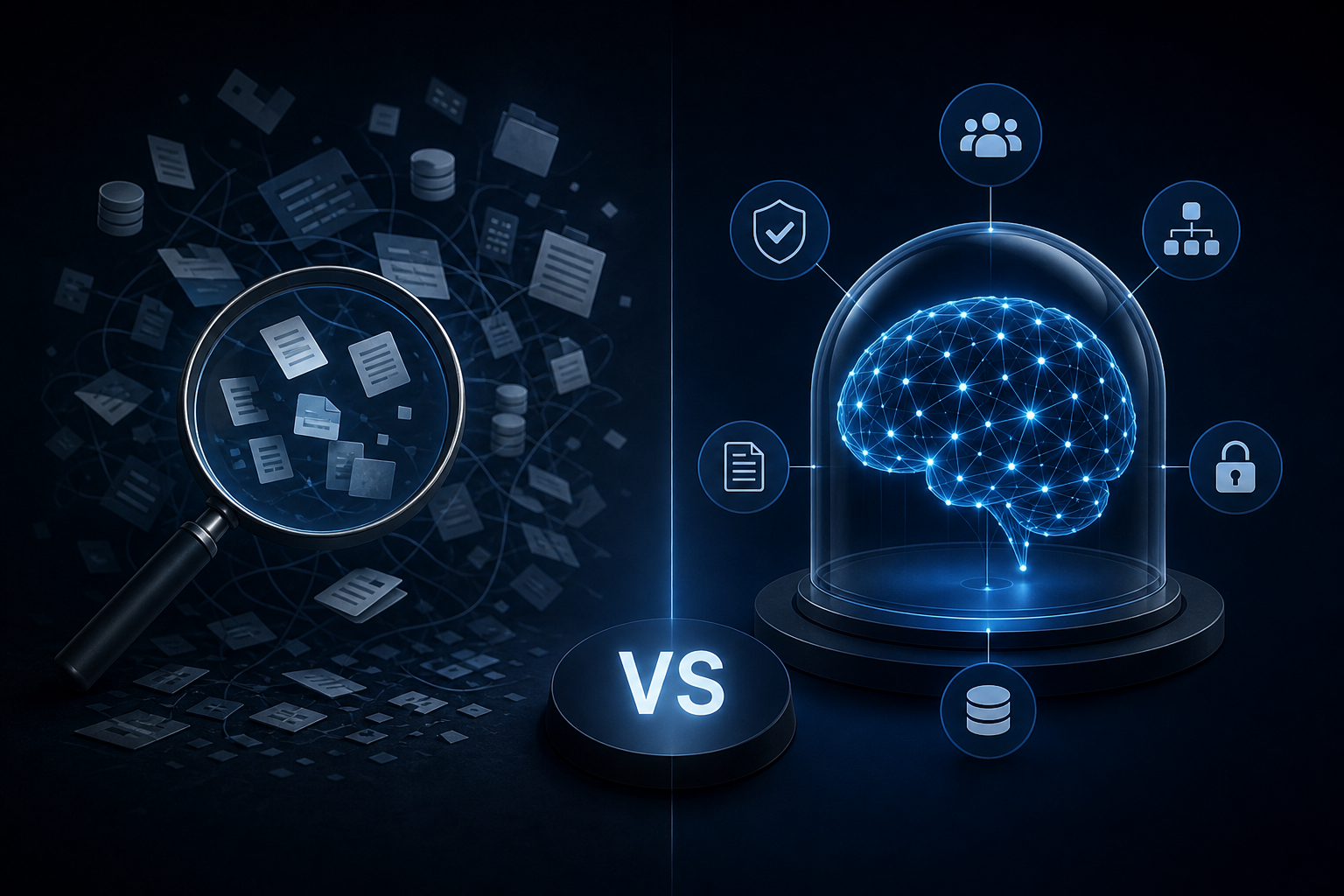
General
Enterprise AI Search vs. a Governed Company Brain: Key Differences
Discover how enterprise ai search differs from a governed company brain and which knowledge approach your team actually needs to act on trusted data.

Learn what an ai context layer is, how it differs from semantic layers and RAG, and the four key components you need to build one that works.
An AI context layer is the governed knowledge tier that sits between your raw data and your AI agents. It translates tables, documents, and metrics into meaning: definitions, relationships, and lineage, so agents can reason accurately without hallucinating. Without it, even well-trained models produce unreliable outputs because they lack the business context to interpret your data correctly.
Most enterprise AI projects don't fail because the model is bad. They fail because the context beneath the model is missing, fragmented, or ungoverned. According to a Cloudera and Harvard Business Review report from early 2026, just 7% of companies believe their data is fully prepared for AI deployment. The remaining majority are pointing agents at a data estate the agents cannot actually understand.
That's the problem this guide solves. You'll get a precise definition, a clear comparison with semantic layers and RAG, the four components you need to build one, and a concrete example of what it looks like when it works.
An AI context layer is the governed meaning tier between your raw data and your AI intelligence. Raw data stores facts: rows, columns, timestamps, IDs. The context layer stores what those facts mean: that "ARR" means annual recurring revenue calculated a specific way, that "customer" in your CRM and "account" in your billing system refer to the same entity, and that a revenue figure from last Tuesday supersedes one from last Thursday.
Without that meaning tier, an AI agent reading your data warehouse is guessing. It may produce a plausible-sounding answer that is factually wrong because it interpreted "closed" as a deal status rather than a fiscal period. That's not a model failure. That's a context failure.
Think of it as three tiers stacked on top of each other: raw data at the bottom, governed meaning and relationships in the middle, and the agents and models that act on it at the top. Most teams build the bottom tier and the top tier and skip the middle. That's why 95% of generative AI pilots in enterprises did not achieve measurable financial impact, per MIT NANDA's 2025 GenAI Divide report.
The context layer is the missing middle.
These terms are often used interchangeably, but they describe different scopes. A semantic layer defines business metrics for BI tools: it tells your dashboard what "revenue" means. A context layer does that and more: it also captures entity relationships, data lineage, governance rules, and the full metadata an AI agent needs to reason across your entire data estate.
RAG (retrieval-augmented generation) is a different tool entirely. RAG fetches relevant documents at query time and injects them into a model's prompt. It's a retrieval mechanism, not a meaning layer. A context layer governs what the data means before any query runs.
Here is how the four layers compare:
Context layer — stores semantic definitions, entity relationships, lineage, and governance rules; primary consumer is AI agents and LLMs; updates continuously via automated pipelines.
Semantic layer — stores metric definitions and business logic for reporting; primary consumer is BI tools and dashboards; updates manually by data or analytics teams.
RAG — stores document chunks and vector embeddings; primary consumer is LLMs at query time; updates on ingestion of new documents.
Memory layer (conversation history) — stores prior turns in a conversation; primary consumer is LLMs within a session; updates per conversation and is ephemeral.
The key distinction: a semantic layer answers "what does this metric mean?" A context layer answers "what does everything in this data estate mean, how does it relate, and can an agent trust it?"
A production-ready enterprise context layer has four building blocks. Skip any one of them and you get partial context, which is often worse than no context at all. Agents act on partial context with false confidence.
Semantic definitions. Every field, metric, and entity in your data estate gets a plain-language definition. "MRR" is defined once, owned by one team, and surfaced to every agent that queries it. No more per-agent interpretations.
Entity resolution. Your CRM calls them "contacts." Your billing system calls them "accounts." Your support tool calls them "users." Entity resolution maps these to a single canonical identity so agents don't double-count or miss records when reasoning across systems.
Lineage. Every data point traces back to its source, its transformation history, and its last verified state. An agent that knows a figure came from a pipeline that last ran 48 hours ago can flag staleness instead of presenting stale data as current fact.
Governance. Access rules, data quality thresholds, and approval workflows sit inside the context layer, not bolted on afterward. This is what makes the layer trusted rather than just populated.
A connectivity standard like the Model Context Protocol (MCP) can link this layer to your agents. Without a shared protocol, each agent integration becomes a custom build.
The gap between claimed readiness and actual readiness is real. DataHub's 2026 State of Context Management report found that while 88% of firms say their context is operational, 61% are actually delaying AI projects because that context isn't practically usable. Building all four components is what closes that gap.
The context window is the amount of text a language model can read and reason over in a single prompt. It's a memory limit measured in tokens. Models vary widely in how much input they can hold at once before earlier content drops out of scope.
This is not the same as a context layer. The context window is temporary and session-specific. Once a conversation ends, everything in that window is gone. The context layer is persistent, governed, and shared across every agent and every session.
A large context window helps an agent hold more information during one task. It does not tell the agent what your data means, which entities are canonical, or whether a figure is trustworthy. A Gartner forecast expects over 40% of agentic AI projects to be canceled by the end of 2027 due to escalating costs, unclear business value, or inadequate risk controls. Stuffing more tokens into a prompt doesn't fix a governance problem.
The context window is a model parameter. The context layer is an architectural decision.
Building a context layer follows four steps in sequence. If you jump to agent integration before validating your data connections, you get the same fragmented outputs you started with.
Step 1: Select your target data warehouse in your management dashboard. Start with one authoritative source: your CRM, your data warehouse, or your ERP. Connecting everything at once creates noise. Pick the system that your agents will query most often and establish the context layer there first.
Step 2: Initialize the setup via an AI assistant conversation. Use a conversational interface to walk through the initial configuration: naming entities, mapping fields, and setting ownership for each semantic definition. This step surfaces conflicts early — two teams calling the same thing different names — before agents encounter them.
Step 3: Validate response accuracy through a test chat. Run 20 to 30 representative queries against the layer before connecting any agents. Compare the outputs against known-correct answers. Atlan's own benchmark found that enhanced metadata delivered a 38% relative improvement in AI-generated SQL accuracy. If your validation queries miss that bar, the semantic definitions need refinement before you proceed.
Step 4: Integrate the context layer with AI agents using the Model Context Protocol (MCP). This step lets agents pull context at runtime rather than relying on hardcoded prompts. Each agent gets the definitions, lineage, and governance rules it needs for each query, dynamically, without a custom integration per agent.
Once MCP integration is live, every new agent you deploy inherits the same governed context automatically.
Picture a 60-person B2B company running Salesforce, HubSpot, QuickBooks, and a custom data warehouse. The sales team queries pipeline data. Finance queries revenue. The ops lead queries both. Every system uses different field names for the same concepts, and no one has mapped them.
An AI agent pointed at this estate without a context layer will hallucinate. It will sum pipeline values using the wrong stage definitions, miss deals that closed in one system but not yet synced to another, and report revenue figures that don't match what finance sees.
With a context layer in place, "opportunity" in Salesforce, "deal" in HubSpot, and "invoice" in QuickBooks all resolve to a single canonical entity. Revenue is defined once, with lineage back to the QuickBooks source. The agent knows which figure is authoritative and when it was last verified.
The practical result shows up even at OpenAI: its in-house data agent took 22 minutes 41 seconds on a question without memory of its data, and 1 minute 22 seconds once that memory let it find the correct tables. That's not a model improvement. That's what context does to execution time.
This is the architecture behind what Singular Innovation calls the Company Brain: a governed, auto-updating knowledge layer that gives every team member and AI worker a single source of truth. If you're evaluating how your own data estate maps to this structure, that page walks through the full architecture.
For teams already using Airtable as a central data hub, the article on Airtable as a Business Data Hub: How to Prepare It for AI Agent Access covers how to prepare that specific system for context layer integration.
Prices and plan limits verified as of October 2026.
What are the 5 layers of AI?
There is no single universal definition. Different frameworks slice enterprise AI architecture differently. A common grouping includes a data layer, a meaning or context layer, a model layer, an agent layer, and an application layer, but the names and boundaries vary by source. The context layer, wherever it appears in a given framework, is the most commonly skipped.
What is the 30% rule for AI?
No widely agreed definition of a rule by that name exists in AI architecture. If you've seen this term in a vendor's report or framework, check the original source for its specific meaning before applying it to your own decisions.
What is context poisoning in AI agents?
Context poisoning happens when false, outdated, or malicious information enters an agent's context layer and the agent acts on it as if it were authoritative. Because agents trust the context layer more than they question it, poisoned context produces confident wrong answers. Governance controls, including data quality thresholds and lineage tracking, are the primary defense. An ungoverned context layer is more vulnerable to poisoning than one with explicit ownership and validation rules.
Can a large context window replace a context layer?
No. A context window holds information for one session and then discards it. A context layer persists across every session, every agent, and every query. A large context window helps an agent reason over more text at once, but it doesn't define what your data means, resolve entity conflicts across systems, or enforce governance rules. Scaling up the context window without a governed context layer just means the agent hallucinates more confidently over a larger input.
How does the Model Context Protocol (MCP) connect agents to a context layer?
MCP is a protocol that lets AI agents request context from a governed layer at query time. Instead of hardcoding definitions and relationships into each agent's system prompt, MCP lets the agent call the context layer dynamically and receive the relevant semantic definitions, lineage, and governance metadata for each specific query. This means every agent you deploy draws from the same governed source, and when the context layer updates, every agent gets the updated meaning automatically.
An AI context layer is the governed meaning tier your agents need to produce reliable outputs. Without it, you're asking models to interpret your data estate without knowing what anything means. The four components — semantic definitions, entity resolution, lineage, and governance — are what separate a context layer that actually works from one that looks operational on paper but stalls every project in practice.
Start by auditing one authoritative data source in your stack. Map its field definitions, identify entity conflicts with connected systems, and validate accuracy before connecting any agents. That sequence — one source, clean definitions, tested outputs — gives you a working foundation you can extend to the rest of your data estate.
Discover how enterprise ai search differs from a governed company brain and which knowledge approach your team actually needs to act on trusted data.
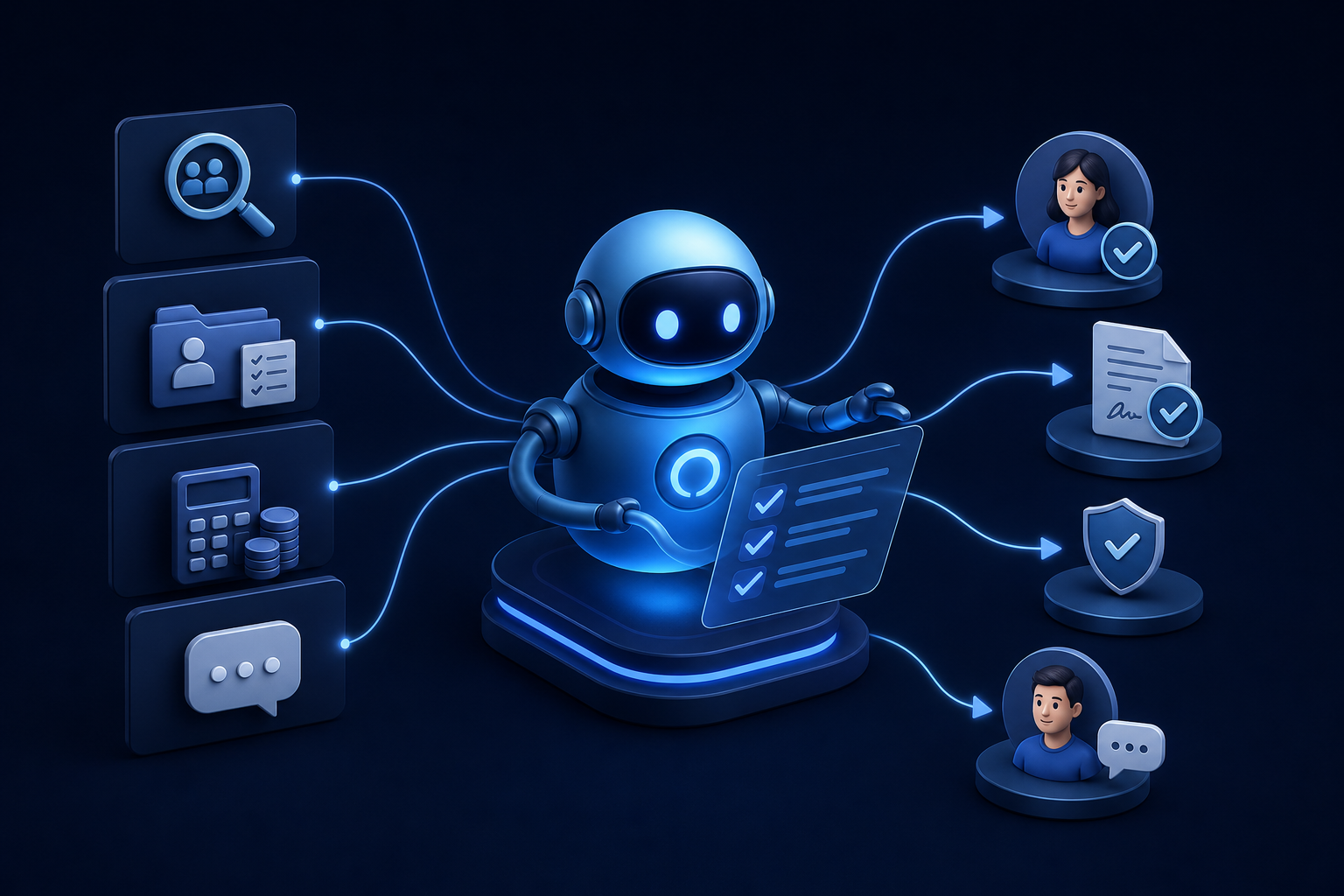
Discover how ai for hr automation handles recruiting, onboarding, payroll checks, and employee Q&A so your team can focus on work that matters.

Explore custom ai agent development paths: build in-house, buy pre-built, or partner with a specialist. Find the right fit for your team today.


