The Vibe Coding Illusion: Why Speed Without Engineering Discipline Destroys Product Value
BDL. Tyler McNulty
Written by
Published on
9 min read
Reading time
Development
Vibe coding accelerates MVP development, but speed without engineering discipline creates technical debt, security risk, and rising maintenance costs. AI-generated code must be governed, tested, and architected properly to protect long-term product value and scalability.
Summarize with AI
Share
The Seductive Promise of Speed
The promise is simple. Type a prompt. Ship a product in weeks.
Vibe coding, using AI to generate production-ready code from natural language, has captured the imagination of founders and executives under pressure to move faster. The interface feels magical. A blinking cursor produces working features in seconds.
But the simplicity of the interface hides a deeper engineering reality.
What works as a prototype often collapses under production stress. What feels like acceleration often becomes deferred cost. And what appears to be savings frequently converts into technical debt that compounds over time.
Speed in development is not the same as speed in delivery.
The Productivity Paradox: What Feels Fast Isn’t Always Fast
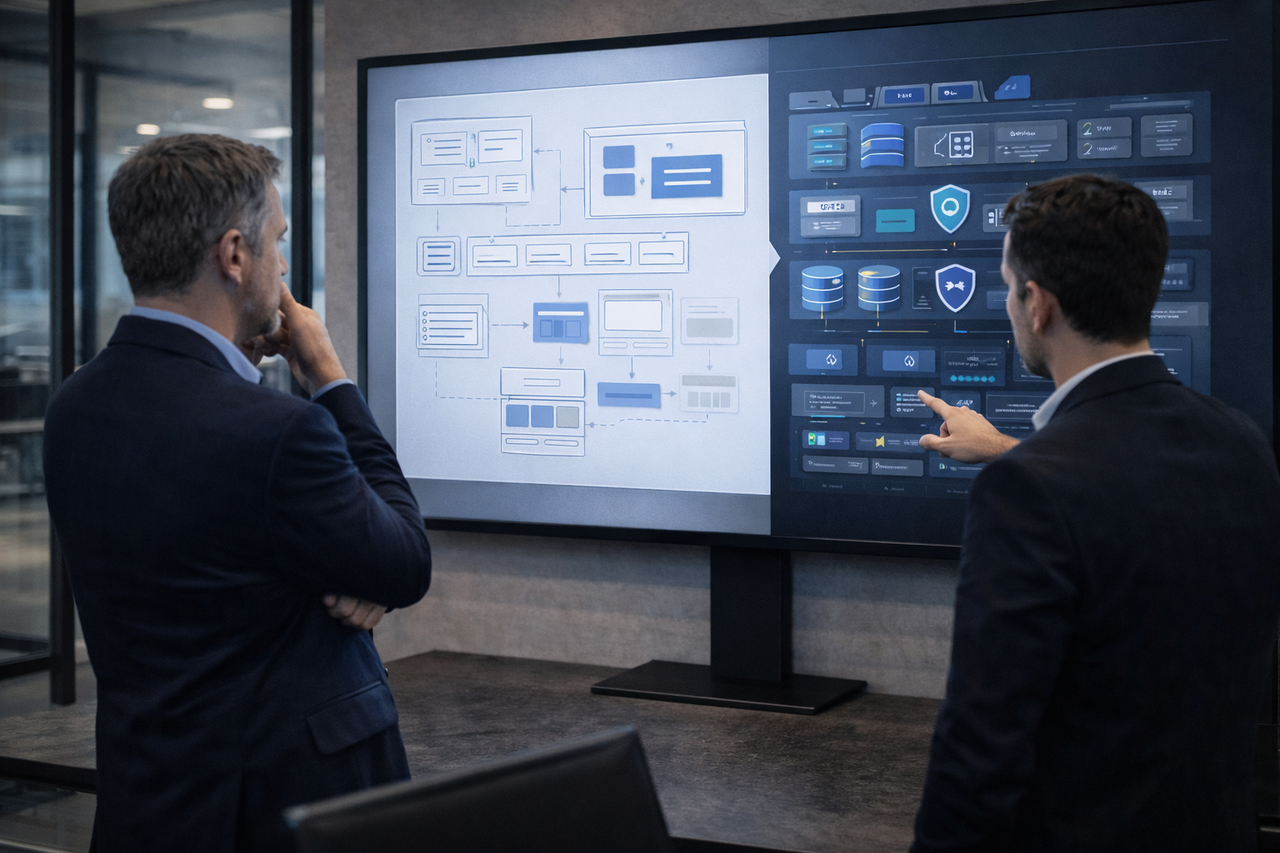
Speed in code generation does not replace the discipline required for production architecture.
AI coding tools are now mainstream. According to industry data from Stack Overflow developer surveys, a majority of engineers use AI coding assistants regularly.
Yet controlled research conducted by Massachusetts Institute of Technology and related labs shows a more nuanced outcome. In realistic engineering tasks, developers using AI tools sometimes take longer to complete work once debugging, refactoring, and verification are measured.
The paradox is psychological and operational:
AI generates code instantly.
Developers feel faster.
Debugging cycles multiply.
Integration friction increases.
Review overhead grows.
The result is often a 19 percent slowdown in real-world completion time, even when developers believe they are moving faster.
This gap between perceived velocity and actual delivery creates dangerous planning errors at the executive level.
The Iceberg Reality of AI-Generated Systems
The visible layer of vibe coding is small.
Above the waterline
Prompts
UI components
API scaffolding
Demo-ready workflows
Below the waterline
Data architecture
Access control systems
Security hardening
Automated testing
Observability and monitoring
Performance optimization
Compliance layers
Vibe coding handles the visible 10 percent extremely well. The submerged 90 percent still requires disciplined engineering.
When founders underestimate the submerged mass, they are not saving money. They are deferring cost into the future.
The Hidden Cost Structure: Low CapEx, Exploding OpEx
Traditional engineering is capital intensive upfront. You invest heavily in architecture, testing, and documentation. Maintenance remains predictable.
Vibe coding reverses the profile:
Low upfront build cost
High long-term maintenance volatility
Increased debugging burden
Greater code churn
Elevated security exposure
AI-generated code frequently introduces duplication, unnecessary abstractions, and subtle hallucinations. Over time, maintenance costs can balloon to 2x or 3x original build cost.
The real financial risk emerges in year two or three, when scaling pressure meets accumulated technical shortcuts.
Security Risk: The 45 Percent Problem
Production readiness requires governance, security controls, and architectural discipline beyond rapid prototyping.
Multiple independent studies show that AI-generated code frequently contains vulnerabilities unless explicitly constrained by secure prompting.
Common patterns include:
Hardcoded secrets
Improper input validation
Weak authentication logic
Incomplete authorization checks
Logging omissions
Even advanced models fail to consistently produce secure implementations without structured guidance.
For production systems handling payments, healthcare data, financial records, or enterprise workflows, this risk is unacceptable.
Security retrofitting is exponentially more expensive than secure-by-design engineering.
The Prototype-to-Production Gap
AI-generated code often requires extensive debugging and engineering review before production deployment.
This is where expectations collapse.
A vibe-coded MVP can be built in 4 to 6 weeks. Turning that MVP into a scalable platform requires:
85 percent plus unit test coverage
Integration testing across systems
Load and stress testing
Database normalization and indexing
Caching strategies
Monitoring dashboards
CI/CD pipelines
Infrastructure hardening
Compliance mapping
In many cases, the production transition requires partial rebuild.
The typical cost delta between prototype and production ranges from $25,000 to $100,000 or more depending on complexity.
That delta is what founders systematically underestimate.
Comprehension Debt: The Silent Killer
Traditional technical debt accumulates gradually.
AI technical debt compounds.
Comprehension debt arises when:
Code is generated by AI
Reviewed superficially
Poorly documented
Poorly understood by humans
When production incidents occur, engineers cannot diagnose issues quickly because they never deeply understood the system.
In fast-growing startups, this becomes catastrophic during scaling inflection points.
Where Vibe Coding Actually Works
Vibe coding delivers strong value in specific contexts:
Rapid MVP validation
Internal admin dashboards
Early feature experimentation
Boilerplate code generation
Acceleration for experienced engineers
It struggles in:
Security-sensitive systems
High-traffic production environments
Deep system integrations
Regulated industries
Mission-critical workflows
The difference between these contexts determines whether vibe coding accelerates growth or destroys value.
Engineering Discipline Is Not Optional
AI acceleration works best when paired with engineering governance.
Organizations must implement:
Mandatory code review for AI-generated code
Security-aware prompt templates
Clear ownership boundaries
Automated testing requirements
Performance benchmarking gates
Architecture review checkpoints
Without these guardrails, AI acceleration simply multiplies future liabilities.
We will evaluate your current architecture, identify hidden technical debt, and outline a clear path from MVP to scalable, secure production.
Move fast. But build correctly.
This article was developed with the support of advanced AI research and editorial assistance tools to synthesize industry data, technical insights, and strategic frameworks. All analysis, positioning, and conclusions reflect the professional expertise and real-world implementation experience of the Singular Innovation team.
Yes. We can turn the article's theme into a practical roadmap, workflow, or build plan for your organization.
No. We start from the painpoint and use discovery to identify whether the answer is strategy, automation, AI, Airtable, product work, or a custom system.
You leave with a clearer first move, the risks to watch, and the path to a measurable deployment if the opportunity is worth pursuing.
See what this means for one workflow.
Review the operating change behind this article, then see how Singular scopes and measures the first release.