



ai-automation
Autonomous Workflows. AI That Runs Operations
Autonomous workflows allow AI to coordinate tasks, decisions, and actions across systems. This shift moves businesses from manual processes to intelligent, self-operating workflows.

Many companies believe AI success comes from better prompts. In reality, most AI implementation failures occur because organizations experiment with tools instead of building operational systems that integrate AI into real workflows.
Artificial intelligence has become widely accessible.
In just a few years, millions of professionals began using AI through chat interfaces. A simple prompt can generate marketing copy, summarize documents, or produce code. The accessibility of these tools created the impression that AI adoption is simple.
Type a prompt. Receive an answer. Move faster.
But this perception hides a deeper operational reality.
While AI tools are powerful, most companies quickly discover that using them does not automatically transform their business operations.
A marketing team may generate better content using AI. A developer might accelerate coding tasks. Analysts may produce summaries more quickly.
Yet across the organization, the underlying workflows remain largely unchanged.
This gap between AI experimentation and operational transformation explains why many companies struggle to capture real business value from artificial intelligence.
In many cases, organizations invest heavily in AI initiatives only to discover that productivity improvements remain limited.
The problem is not the technology.
The problem is the absence of architecture.
Without systems that integrate AI into real workflows, companies are left with isolated experiments rather than operational intelligence.
Understanding this distinction is essential to avoiding one of the most common outcomes in modern digital transformation: AI implementation failure.

Many AI initiatives fail when organizations rely on isolated prompt-based tools instead of building integrated operational systems.
The early wave of AI adoption was driven by tools.
Organizations experimented with chat-based assistants, writing generators, and AI-powered productivity features embedded in various applications.
These tools demonstrated that AI could accelerate certain tasks dramatically.
However, tools alone cannot transform operational systems.
Businesses operate through complex workflows that connect multiple departments, applications, and decision processes. AI can influence these workflows only if it is integrated into the underlying operational architecture.
This is where many companies encounter challenges.
Instead of designing systems that incorporate AI into workflows, organizations often attempt to deploy AI as an overlay on top of existing processes.
Employees are encouraged to "use AI more often." Teams experiment with prompts and copilots.
But the workflows themselves remain unchanged.
As a result, AI operates outside the system rather than within it.
This difference may seem subtle, but it fundamentally determines whether AI produces incremental productivity gains or structural operational improvements.

Disconnected AI tools create operational friction as teams manually reconcile information across multiple systems.
One of the most persistent myths in the AI ecosystem is the belief that better prompts lead to better outcomes.
Prompt engineering can certainly improve the quality of AI outputs. However, prompts alone cannot transform operational processes.
Consider a typical business workflow.
A sales team generates leads. Marketing campaigns create inbound traffic. Customer service teams handle inquiries. Finance tracks revenue.
Each step produces data and requires coordination across systems.
If AI is introduced only through isolated prompts, it may assist individual tasks within this workflow.
But the coordination between systems remains unchanged.
Employees still move information manually between tools. Reporting still requires compiling data from multiple platforms. Operational decisions remain reactive rather than proactive.
In other words, the company gains a faster assistant but not a smarter system.
This distinction explains why many organizations experience disappointment after early AI experiments.
Initial demonstrations appear impressive. Real operational impact remains limited.
Organizations that successfully deploy AI approach the technology differently.
Rather than focusing on prompts, they focus on systems architecture.
AI becomes part of an operational layer that connects data sources, applications, and workflows across the organization.
In this architecture, AI agents analyze operational data continuously rather than responding to isolated prompts.
Workflows become automated rather than manually coordinated.
For example, instead of asking an AI assistant to generate a report, the system itself can monitor operational metrics and automatically produce insights.
Instead of manually analyzing customer support trends, AI can detect patterns across support tickets and trigger alerts when systemic issues appear.
This model transforms AI from a reactive tool into an active operational component.
The key difference lies in how the system is designed.
Prompts interact with AI.
Architecture integrates AI.
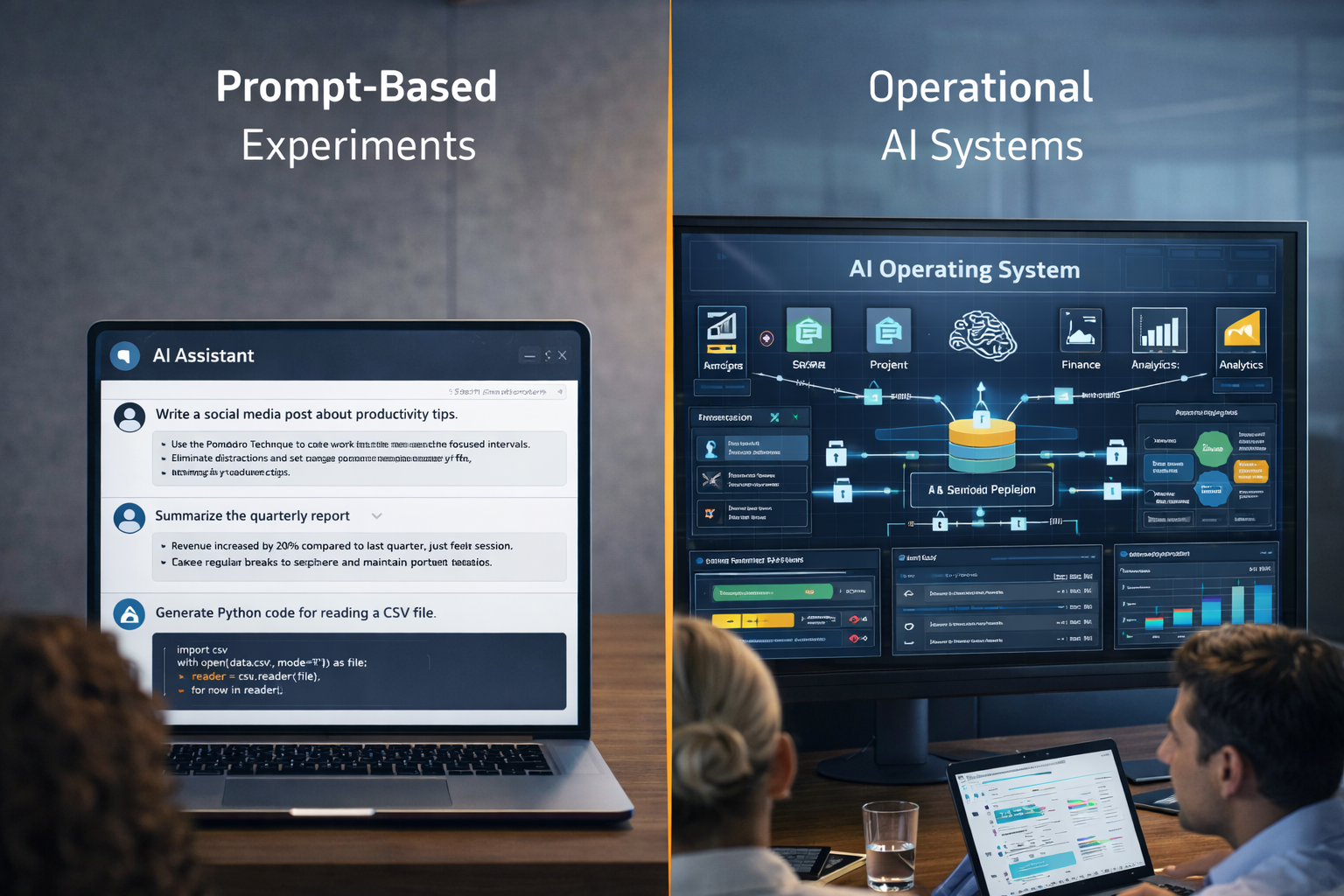
Prompt-based AI experiments generate isolated outputs, while operational AI systems connect data, workflows, and business applications.
Large organizations often struggle with AI implementation because their infrastructure evolved over decades.
Legacy systems, fragmented data sources, and complex governance structures make integration difficult.
Small and mid-market companies often operate with more modern digital stacks.
Their tools are cloud-based, APIs are widely available, and operational processes can be redesigned more quickly.
This flexibility allows SMBs to build AI-enabled operational systems without the heavy constraints faced by large enterprises.
However, SMBs also face a different risk.
Because AI tools are so accessible, many organizations rely on quick experiments rather than building structured operational systems.
The temptation to adopt "cheap AI" solutions is strong.
But without architectural thinking, these experiments rarely scale.
Organizations can avoid AI implementation failure by approaching the technology as an operational system rather than a tool.
Step 1. Identify operational workflows
Focus on processes that coordinate multiple systems, such as customer onboarding, sales pipeline management, or project delivery.
These workflows represent the highest leverage opportunities for AI.
Step 2. Establish an operational data layer
Ensure that relevant data from different systems can be accessed and structured in a centralized environment.
Without reliable data infrastructure, AI systems cannot produce consistent results.
Step 3. Design automated workflows
Instead of relying on manual coordination, create workflows that trigger actions automatically across systems.
Automation platforms and integration tools can support this orchestration.
Step 4. Deploy AI as operational intelligence
Once workflows and data infrastructure are established, AI can analyze patterns, detect anomalies, and support decision making.
At this stage, AI becomes an integral component of the operational system.
Consider a marketing agency experimenting with AI.
The team initially uses AI tools to generate marketing copy and analyze campaign performance. While these tools accelerate individual tasks, the overall workflow remains fragmented.
Campaign data lives in multiple platforms. Reporting requires manual compilation. Performance insights are delayed.
The agency decides to redesign its operational architecture.
Data from advertising platforms, CRM systems, and analytics tools is consolidated into a central operational database. Automated workflows connect campaign activity with reporting dashboards.
AI agents monitor campaign performance continuously.
When conversion rates decline or budget efficiency drops, the system automatically generates insights and suggests adjustments.
Instead of reacting to problems after they occur, the agency operates with continuous operational intelligence.
The next phase of AI adoption will likely shift away from prompt-based interactions toward operational systems.
Organizations will increasingly design infrastructures where AI monitors workflows, analyzes operational data, and supports decision making continuously.
In these environments, AI becomes less visible as a tool and more embedded within the organization's operational fabric.
The companies that succeed in this transition will not necessarily have access to better AI models.
Instead, they will build better operational architectures.
The difference between experimentation and transformation will become increasingly clear.
Artificial intelligence is not a shortcut to operational excellence.
While prompts can generate impressive outputs, they do not redesign workflows or integrate systems.
Real value emerges when AI becomes part of a structured operational architecture.
Companies that focus only on tools risk falling into the trap of AI implementation failure.
Those that design systems where AI interacts with real workflows will unlock far greater operational impact.
The difference lies not in the technology itself, but in how organizations choose to implement it.
Many AI initiatives fail because organizations focus on prompts rather than operational systems.
AI tools can improve individual tasks but rarely transform workflows on their own.
Operational architecture determines whether AI creates real business value.
Companies must connect data sources and workflows before AI can deliver consistent insights.
AI agents can monitor operations continuously when integrated into operational systems.
SMBs can deploy AI systems quickly if they adopt architectural thinking.
The future of AI adoption will focus on systems rather than isolated tools.
Why do many AI implementations fail?
AI implementation often fails because organizations experiment with tools without integrating AI into their operational workflows and systems.
Are prompts enough to implement AI in a company?
No. Prompts can assist with individual tasks, but real operational value requires AI to be integrated into workflows and business systems.
What is the difference between AI tools and AI systems?
AI tools support isolated tasks, while AI systems connect data, workflows, and applications to automate decision making across operations.
Can SMBs successfully implement AI systems?
Yes. Modern cloud infrastructure and no-code platforms allow SMBs to design operational AI systems without large engineering teams.
What causes hidden costs in AI adoption?
Hidden costs arise when organizations invest in AI tools that fail to integrate with existing workflows, resulting in limited operational impact.
AI Implementation Failure
A situation where organizations adopt AI tools but fail to generate meaningful operational improvements.
Prompt Engineering
The practice of crafting instructions that improve the output quality of AI models.
Operational AI
Artificial intelligence integrated into business systems that supports decision making and workflow automation.
AI Workflow Architecture
The system design that connects applications, data sources, and automation workflows to enable AI-driven operations.
AI Operational Platform
A digital infrastructure where AI continuously analyzes operational data and coordinates workflows.
McKinsey reports that more than half of organizations experimenting with AI struggle to scale it across operations.
Gartner estimates that many AI projects fail to deliver expected ROI due to poor integration with business workflows.
Deloitte research shows that companies with integrated data architectures achieve significantly higher AI value realization.
Harvard Business Review highlights organizational design as one of the primary barriers to successful AI adoption.
Companies exploring how AI can move beyond experimentation into real operational systems are beginning to redesign the workflows behind their tools.
Singular Innovation helps SMBs design and build custom AI-powered operational platforms using Airtable Omni and modern no-code infrastructure.
This article was developed with the assistance of artificial intelligence tools to support research, structure, and editorial drafting. All strategic analysis, validation, and final editorial review were conducted by the Singular Innovation team.
Autonomous workflows allow AI to coordinate tasks, decisions, and actions across systems. This shift moves businesses from manual processes to intelligent, self-operating workflows.

Dashboards show what happened. AI operations systems decide and act on what should happen next. This shift is redefining how companies run their day to day operations.

LLMs are powerful, but prompts alone do not create business impact. Real value comes from embedding LLMs into workflows that connect data, decisions, and actions across systems.


