



ai-automation
Autonomous Workflows. AI That Runs Operations
Autonomous workflows allow AI to coordinate tasks, decisions, and actions across systems. This shift moves businesses from manual processes to intelligent, self-operating workflows.
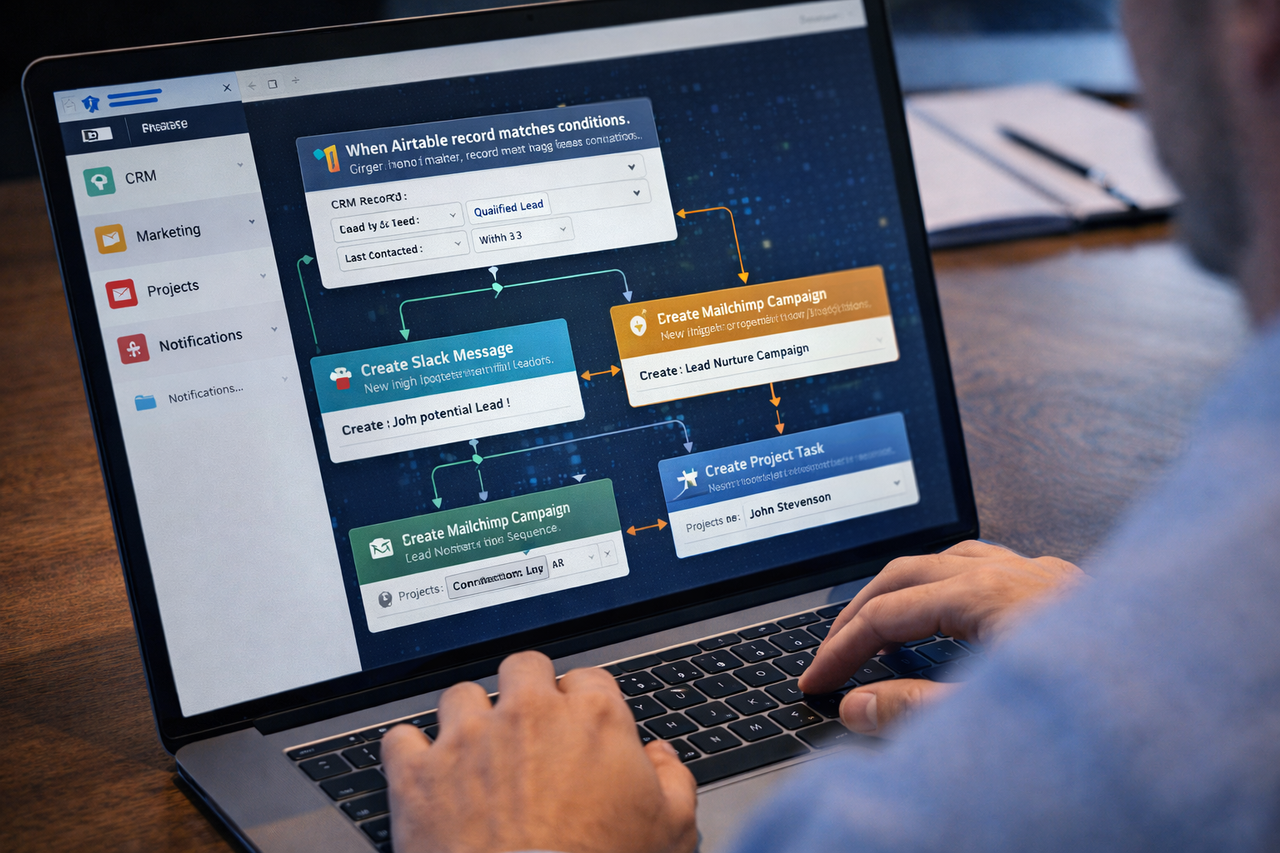
SMBs can now build AI workflows without engineering teams. No-code platforms like Airtable Omni allow companies to connect apps, automate processes, and deploy AI agents that manage operations across their digital systems.
For years, implementing automation in business operations required engineering teams.
Companies needed developers to connect systems, build integrations, and design workflow automation tools capable of coordinating complex processes. This reality made operational automation largely inaccessible to small and mid-market businesses.
Large enterprises could invest in custom software development. Smaller companies had to rely on manual coordination between tools.
Artificial intelligence and no-code infrastructure are changing that dynamic.
Today, SMBs can design AI workflows that connect applications, automate processes, and analyze operational data without writing software code.
Instead of relying on engineering teams, modern platforms allow operations leaders to build digital workflows directly.
This shift is particularly significant because most business operations depend on coordination across multiple systems.
Customer onboarding requires communication between sales tools, billing systems, and project management platforms. Marketing campaigns rely on data from analytics tools and CRM systems. Financial reporting requires information from accounting software and operational dashboards.
Without automation, employees manually move information between these systems.
AI workflows provide a new approach.
By connecting applications, structuring operational data, and deploying AI agents to analyze activity across systems, SMBs can build intelligent operational environments that run continuously in the background.
Understanding how these systems work is becoming an essential capability for modern business operators.
Automation has existed in business technology for many years.
Traditional workflow automation tools allowed companies to trigger actions based on predefined rules. For example, a new form submission might create a CRM contact or send a notification to a sales team.
These systems improved efficiency, but they were limited.
They relied entirely on predefined logic.
Artificial intelligence introduces a new capability.
AI workflows can interpret operational data and generate insights that influence how workflows operate.
Instead of executing rigid rules, AI-powered workflows can adapt to changing conditions.
For example, an AI workflow monitoring sales pipelines could identify patterns indicating declining conversion rates. The system might alert sales teams, suggest adjustments, or trigger new outreach sequences.
Similarly, an AI workflow managing customer support could detect recurring issues and escalate them automatically.
This combination of automation and intelligence transforms workflows into operational systems capable of continuous analysis and action.
Many organizations assume automation begins with technology.
In reality, effective automation begins with workflow design.
Companies often attempt to automate individual tasks rather than the operational processes that connect them.
For example, a marketing team may automate email campaigns. A finance team may automate invoice generation. A customer support team may implement ticket routing rules.
Each automation improves a specific function, but the broader workflow remains fragmented.
True AI workflows coordinate activity across multiple systems and departments.
They connect applications, consolidate operational data, and orchestrate processes across the organization.
Without this architecture, automation remains limited to isolated improvements.
Building AI workflows for SMB operations typically involves three layers.
Application layer
This layer includes the tools businesses already use.
CRM platforms manage customer relationships. Marketing software handles campaigns. Accounting tools track financial activity. Project management tools coordinate tasks.
These applications generate operational data but rarely communicate seamlessly with each other.
Operational workflow layer
This layer coordinates workflows across applications.
Platforms such as Airtable Omni can function as an operational engine that structures business data, connects systems, and manages workflows.
Instead of relying on disconnected tools, organizations create a centralized environment where operational processes are orchestrated.
AI intelligence layer
Artificial intelligence enhances this architecture by analyzing operational data and supporting decision making.
AI agents can monitor workflows, detect anomalies, and recommend actions based on patterns across systems.
Over time, this infrastructure becomes a fully integrated AI workflow system.
Small and mid-market businesses often have a unique advantage when implementing AI workflows.
Unlike large enterprises, they typically operate with fewer legacy systems and simpler organizational structures.
This flexibility allows SMBs to redesign workflows more quickly.
No-code platforms play a critical role in enabling this shift.
Tools such as Airtable Omni allow companies to build structured operational systems without traditional software development.
Operations teams can design databases, workflows, dashboards, and automation processes within a single environment.
This approach reduces the dependency on engineering resources while increasing the speed of implementation.
SMBs can begin building AI workflows using a structured approach.
Step 1. Map operational processes
Identify workflows that require coordination across multiple systems.
Customer onboarding, sales pipelines, project delivery, and reporting processes often represent strong starting points.
Step 2. Centralize operational data
Create a structured operational database that consolidates data from multiple applications.
This database becomes the foundation for automation and AI analysis.
Step 3. Automate cross-system workflows
Design workflows that trigger actions across systems automatically.
For example, a closed sales deal might automatically generate project tasks, billing records, and onboarding communications.
Step 4. Deploy AI intelligence
Once workflows and data infrastructure are in place, AI can analyze operational patterns and generate insights that improve decision making.
Over time, these systems evolve into intelligent operational platforms.
Consider a digital marketing agency managing dozens of client campaigns simultaneously.
Each campaign generates data from advertising platforms, analytics tools, and CRM systems.
Without automation, account managers must manually gather performance data, prepare reports, and coordinate campaign adjustments.
By building AI workflows, the agency can automate this process.
Campaign data flows into a centralized operational database. Automated workflows generate performance dashboards and update campaign records.
AI agents analyze campaign performance continuously.
When certain performance thresholds are reached, the system generates recommendations for budget allocation or creative adjustments.
Account managers focus on strategy rather than manual reporting.
As no-code platforms and AI technologies evolve, the barrier to building operational systems will continue to decline.
More organizations will design custom operational infrastructures tailored to their workflows rather than relying solely on off-the-shelf software.
AI workflows will become a core component of digital operations.
Instead of reacting to operational data after the fact, companies will operate through systems that continuously analyze and optimize business activity.
For SMBs, this transformation may represent one of the most important opportunities to increase efficiency and competitiveness.
Automation is no longer limited to large enterprises with engineering resources.
Modern no-code infrastructure allows SMBs to build AI workflows that coordinate applications, analyze operational data, and automate business processes.
The companies that adopt these capabilities early will likely operate with greater efficiency, better visibility into their operations, and faster decision making.
In the coming years, the ability to design operational workflows may become as important as the tools companies choose to use.
SMBs can now build AI workflows without engineering teams.
No-code platforms enable companies to design operational systems directly.
AI workflows connect applications, data, and automation processes.
Platforms like Airtable Omni can function as an operational workflow engine.
AI agents analyze operational data and improve decision making.
Automation becomes more powerful when workflows are connected across systems.
Operational AI systems allow SMBs to operate more efficiently.
What are AI workflows for SMBs?
AI workflows are automated operational processes that connect applications, data, and automation systems to improve efficiency and decision making.
Do SMBs need engineers to build AI workflows?
No. Modern no-code platforms allow operations teams to design workflows and automation systems without software development.
How does Airtable Omni support AI workflows?
Airtable Omni can act as an operational platform that connects data, workflows, and automation across multiple business systems.
What processes can AI workflows automate?
Sales pipelines, customer onboarding, project management, marketing analytics, financial reporting, and customer support operations.
Why are AI workflows important for SMBs?
They reduce manual coordination between systems and allow companies to operate with greater efficiency and intelligence.
AI Workflow
An automated operational process enhanced by artificial intelligence that analyzes data and coordinates actions across systems.
No-Code Infrastructure
Platforms that allow companies to build applications and automation systems without writing software code.
Operational Data Layer
A centralized environment where business data from multiple applications is structured and coordinated.
AI Automation
The use of artificial intelligence to trigger automated actions based on operational data patterns.
Operational Platform
A system that connects workflows, applications, and data into a unified operational environment.
McKinsey reports that a growing percentage of organizations are integrating AI into operational workflows.
Gartner predicts increasing adoption of AI-driven automation across business applications.
Deloitte research highlights the importance of integrated data systems for successful AI implementation.
Harvard Business Review identifies workflow redesign as a critical factor in digital transformation.
Companies exploring how AI can move beyond experimentation into real operational systems are beginning to redesign the workflows behind their tools.
Singular Innovation helps SMBs design and build custom AI-powered operational platforms using Airtable Omni and modern no-code infrastructure.
This article was developed with the assistance of artificial intelligence tools to support research, structure, and editorial drafting. All strategic analysis, validation, and final editorial review were conducted by the Singular Innovation team.
Autonomous workflows allow AI to coordinate tasks, decisions, and actions across systems. This shift moves businesses from manual processes to intelligent, self-operating workflows.

Dashboards show what happened. AI operations systems decide and act on what should happen next. This shift is redefining how companies run their day to day operations.

LLMs are powerful, but prompts alone do not create business impact. Real value comes from embedding LLMs into workflows that connect data, decisions, and actions across systems.


