



ai-automation
Autonomous Workflows. AI That Runs Operations
Autonomous workflows allow AI to coordinate tasks, decisions, and actions across systems. This shift moves businesses from manual processes to intelligent, self-operating workflows.
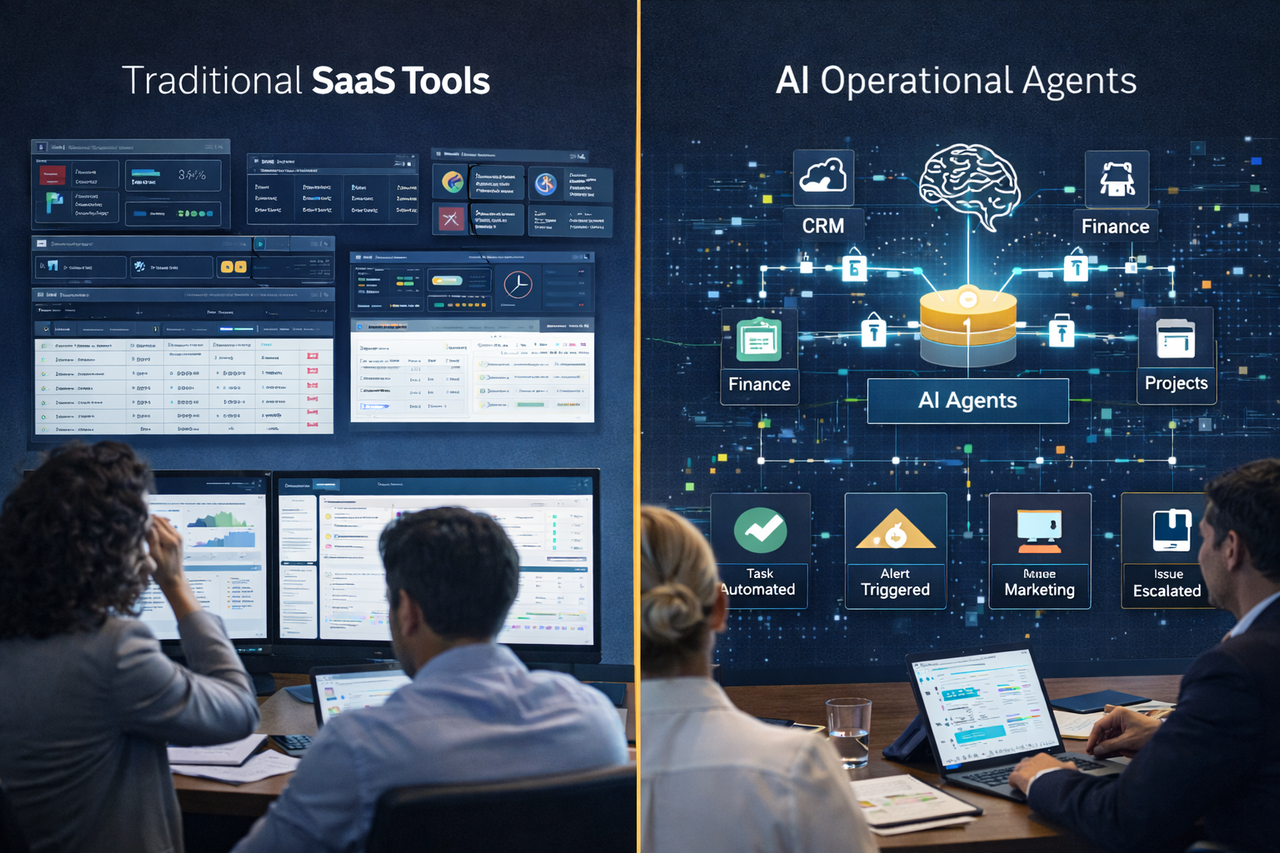
Business software is evolving from static SaaS tools to intelligent AI agents. Instead of dashboards that report activity, AI agents actively manage workflows, analyze data, and automate decisions across company operations.
For the last two decades, software as a service transformed how businesses operate.
Instead of installing software locally, companies began using cloud platforms that delivered applications through the browser. Customer relationship management, accounting, project management, marketing automation, and analytics tools all became accessible as SaaS products.
This shift dramatically reduced the cost and complexity of deploying software.
Companies could subscribe to specialized tools rather than building their own systems.
Yet as organizations adopted dozens of SaaS applications, a new problem emerged.
Most SaaS tools function primarily as interfaces for human interaction.
Dashboards display information. Users interpret the data. Actions are executed manually.
The system informs the user, but the user still performs the operational work.
Artificial intelligence is now changing this dynamic.
Instead of simply displaying information, software systems can now analyze operational data and execute tasks autonomously.
This capability is giving rise to a new model of software: AI agents.
Rather than replacing SaaS entirely, AI agents represent the next evolution of business software. They transform software from passive dashboards into active operational systems.
Understanding this transition may be essential for companies preparing their digital infrastructure for the next decade.
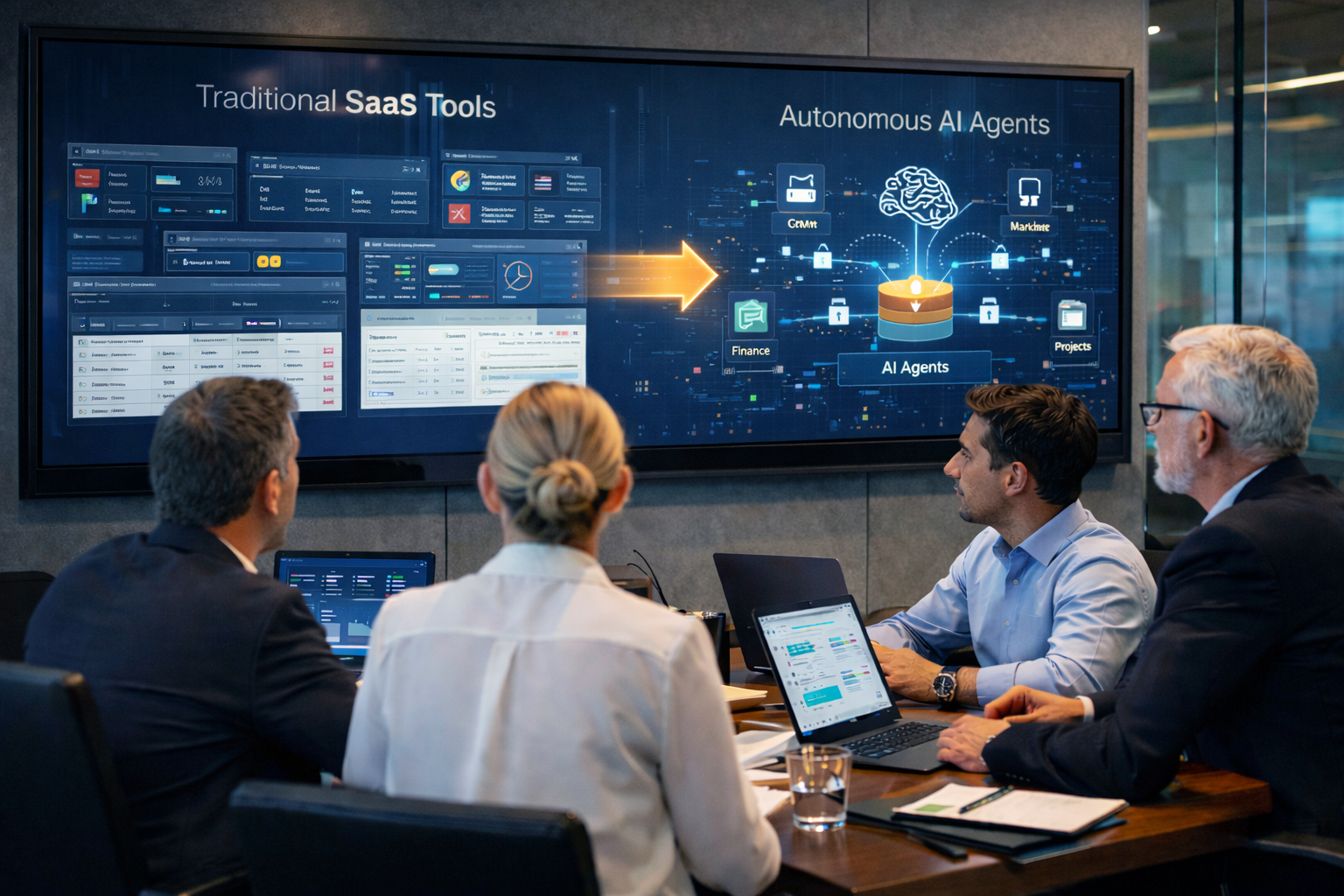
Traditional SaaS applications are built around a simple model.
They store data, provide interfaces for users to interact with that data, and generate reports or dashboards that summarize activity.
The system provides visibility.
Humans provide execution.
This model worked well when data volumes were manageable and workflows were relatively simple.
However, modern organizations generate massive amounts of operational data across dozens of platforms.
Sales pipelines, customer interactions, marketing campaigns, financial transactions, project workflows, and support requests all produce continuous streams of information.
Expecting humans to manually interpret this data and coordinate decisions across systems is increasingly inefficient.
AI agents change this model.
Instead of waiting for users to review dashboards, AI agents can continuously analyze operational data and trigger actions automatically.
For example, an AI agent monitoring a sales pipeline could detect declining conversion rates and recommend adjustments to outreach strategies.
Another agent could monitor customer support activity and escalate issues when patterns indicate product failures.
The system becomes proactive rather than reactive.
Many organizations believe AI will simply enhance existing SaaS tools.
In reality, the deeper transformation may occur at the architectural level.
Traditional SaaS platforms were designed primarily as data management and reporting systems.
AI agents are designed as decision and execution systems.
This difference is significant.
Dashboards require humans to interpret information and initiate actions.
AI agents can perform both analysis and execution within defined operational frameworks.
This does not mean dashboards will disappear entirely.
Rather, their role will change.
Instead of serving as the primary interface for operational management, dashboards may become secondary views into systems that are largely automated.
Companies that recognize this shift early will likely design their digital infrastructure differently.
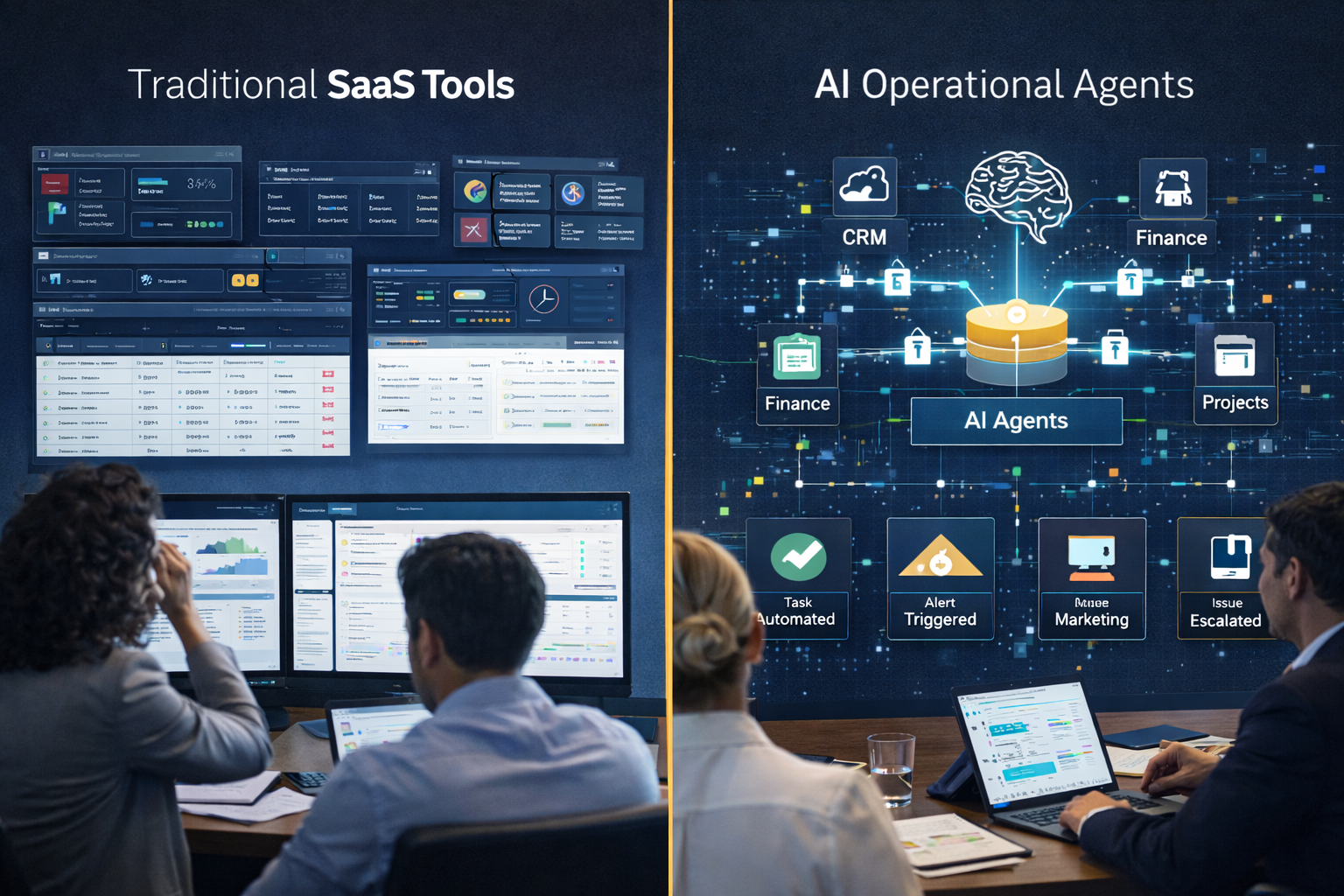
In an AI agent-based architecture, software systems are organized into three layers.
Application layer
This layer includes traditional SaaS tools such as CRM platforms, accounting systems, marketing automation software, and project management tools.
These applications generate and store operational data.
Operational data layer
This layer consolidates data across systems and creates a unified operational environment.
Platforms such as Airtable Omni can serve as this layer, enabling companies to structure workflows, connect applications, and manage operational data in a flexible environment.
AI agent layer
This is where intelligence operates.
AI agents analyze operational data, monitor workflows, and trigger automated actions across the digital stack.
For example, a revenue operations agent might monitor sales activity, marketing campaign performance, and pipeline health simultaneously.
If certain thresholds are reached, the system could automatically generate alerts, recommend strategies, or trigger workflow adjustments.
In this model, software becomes less about interacting with interfaces and more about designing intelligent operational systems.
Small and mid-market businesses often operate with fewer technological constraints than large enterprises.
While large corporations may rely on legacy software stacks accumulated over decades, SMBs typically adopt modern cloud tools.
This flexibility allows SMBs to redesign their digital infrastructure more easily.
AI agents enable SMBs to operate with capabilities previously available only to large enterprises.
For example, an SMB could deploy AI agents that monitor financial performance, track sales pipelines, and manage project workflows simultaneously.
Instead of hiring large operational teams to coordinate these activities manually, companies can build systems that automate much of the work.
This shift can dramatically increase operational efficiency.
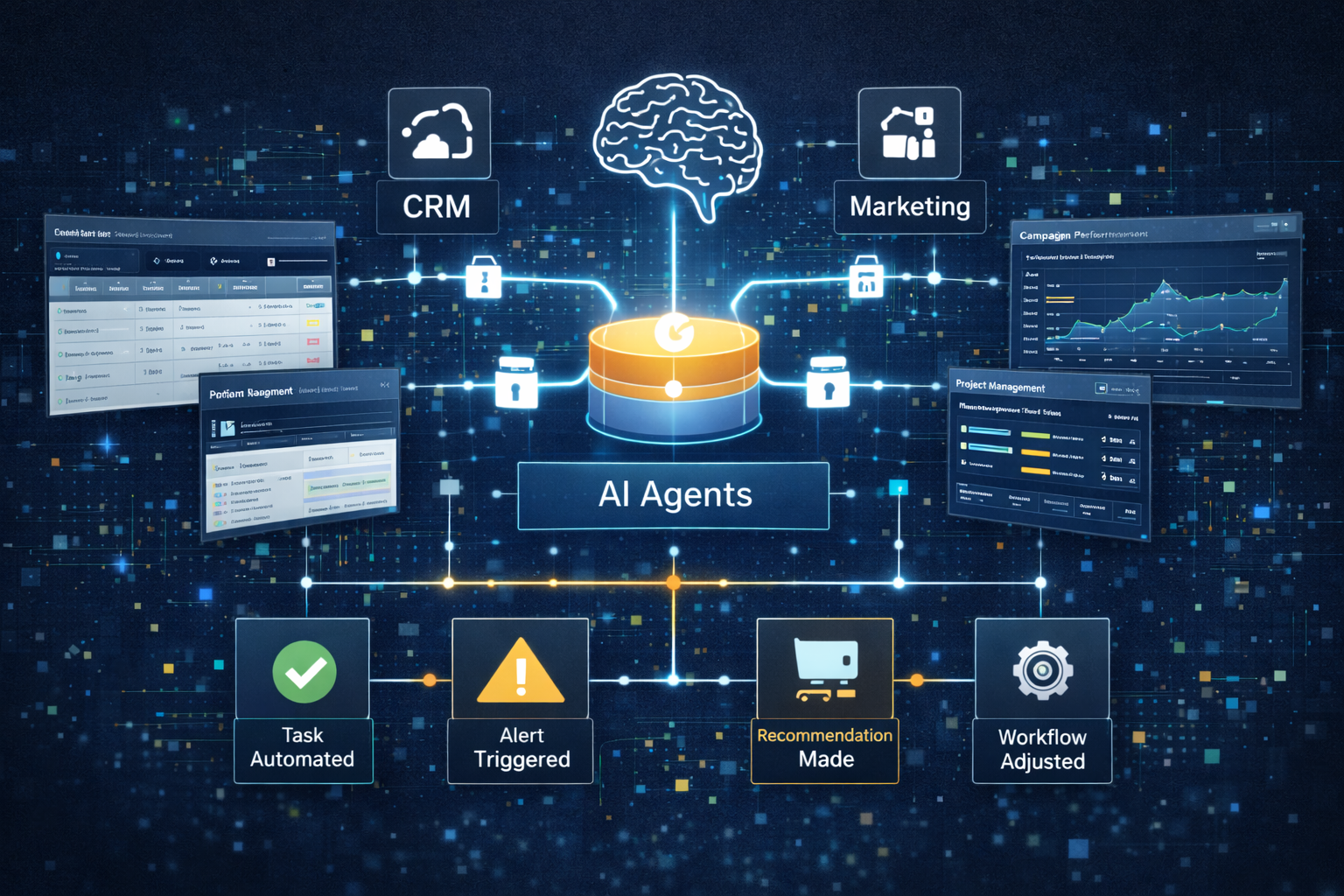
Companies interested in transitioning toward AI agent-based systems can follow a structured approach.
Step 1. Map operational workflows
Identify the processes that coordinate multiple systems. These workflows often represent the best opportunities for automation.
Step 2. Connect operational data
Ensure that core business data from different applications can be consolidated and structured in a centralized operational layer.
Step 3. Design workflow automation
Implement automation that connects systems and triggers actions across applications based on operational events.
Step 4. Deploy AI agents
Once workflows are integrated, AI agents can monitor operational data and assist with decision making.
Over time, this architecture transforms traditional SaaS stacks into intelligent operational systems.
Consider a growing e-commerce company managing multiple sales channels.
Traditional SaaS tools handle inventory, customer relationships, marketing campaigns, and financial reporting.
Managers must monitor multiple dashboards to understand how the business is performing.
With an AI agent-based architecture, the system can analyze these data sources continuously.
If inventory levels fall below thresholds while demand increases, the AI agent can alert operations teams and recommend restocking strategies.
If marketing campaigns begin generating higher conversion rates, the system can automatically allocate additional budget.
Rather than manually coordinating these activities, the company operates through an intelligent operational system.
The next generation of business software will likely combine SaaS infrastructure with AI agents that manage operational workflows.
Instead of relying on dozens of tools that require constant human supervision, companies will design systems where AI agents coordinate activities across applications.
This transformation will likely change how companies think about software procurement.
Organizations may prioritize platforms that enable operational orchestration rather than standalone applications.
Over time, the distinction between "software tools" and "operational systems" may become increasingly clear.
Companies that adopt AI agent architectures early may gain a significant operational advantage.
Software is entering a new phase of evolution.
While SaaS tools transformed access to software, they largely preserved the model of humans managing operational workflows.
AI agents represent a shift toward systems that can analyze data and execute actions autonomously.
Rather than replacing SaaS entirely, AI agents are likely to become the operational layer that connects and coordinates existing software systems.
The companies that recognize this transition early will design infrastructures capable of operating at a new level of efficiency and intelligence.
AI agents represent the next evolution of business software beyond traditional SaaS tools.
SaaS platforms provide dashboards and interfaces, while AI agents perform analysis and execution.
Businesses generate more operational data than humans can efficiently analyze manually.
AI agents enable proactive operational management across multiple systems.
SMBs can deploy AI agents faster than enterprises due to simpler infrastructure.
The future of business software will likely combine SaaS platforms with operational AI agents.
Companies that adopt AI agent architectures early may gain significant operational advantages.
What is the difference between AI agents and SaaS tools?
SaaS tools primarily store data and provide dashboards for human interaction, while AI agents analyze operational data and automate actions across workflows.
Will AI agents replace SaaS software?
AI agents are more likely to augment SaaS platforms by acting as an operational layer that coordinates activities across applications.
Why are AI agents important for business operations?
They allow organizations to analyze large volumes of operational data and automate decisions that previously required manual coordination.
Can SMBs use AI agents in their operations?
Yes. Modern APIs, automation platforms, and no-code tools allow SMBs to deploy AI agents without large engineering teams.
What types of workflows can AI agents manage?
Sales pipelines, marketing campaigns, financial monitoring, project management, customer support analysis, and operational reporting.
AI Agent
An intelligent system that analyzes operational data and executes actions across business workflows.
Software as a Service (SaaS)
Cloud-based software applications that provide tools through web interfaces.
Operational AI
Artificial intelligence integrated into business processes to support automated decision making.
Workflow Automation
The orchestration of tasks and processes across systems without manual intervention.
Operational Platform
A system that connects applications, data, and workflows into a unified operational environment.
McKinsey research indicates that more than half of companies are already experimenting with AI in core business functions.
Gartner predicts that AI capabilities will be integrated into most enterprise software platforms in the coming years.
Deloitte research highlights data integration as a critical factor in successful AI adoption.
Harvard Business Review identifies organizational architecture as a key determinant of digital transformation success.
Companies exploring how AI can move beyond experimentation into real operational systems are beginning to redesign the workflows behind their tools.
Singular Innovation helps SMBs design and build custom AI-powered operational platforms using Airtable Omni and modern no-code infrastructure.
This article was developed with the assistance of artificial intelligence tools to support research, structure, and editorial drafting. All strategic analysis, validation, and final editorial review were conducted by the Singular Innovation team.
Autonomous workflows allow AI to coordinate tasks, decisions, and actions across systems. This shift moves businesses from manual processes to intelligent, self-operating workflows.

Dashboards show what happened. AI operations systems decide and act on what should happen next. This shift is redefining how companies run their day to day operations.

LLMs are powerful, but prompts alone do not create business impact. Real value comes from embedding LLMs into workflows that connect data, decisions, and actions across systems.


