



ai-automation
Autonomous Workflows. AI That Runs Operations
Autonomous workflows allow AI to coordinate tasks, decisions, and actions across systems. This shift moves businesses from manual processes to intelligent, self-operating workflows.

This article explains how AI-augmented workflows are reshaping digital product development. It outlines the Singular Innovation framework, showing how organizations combine human expertise, no-code platforms, and artificial intelligence to increase speed, flexibility, and long-term adaptability.
AI-augmented workflows are systems where artificial intelligence supports execution and decision-making while humans retain orchestration, judgment, and responsibility for outcomes.
Digital transformation is no longer optional. Yet many organizations continue to operate with fragmented technology stacks, siloed teams, and development cycles that cannot keep pace with market change.
The core issue is not a lack of tools. It is an architectural mindset that treats digital transformation as a sequence of isolated projects rather than as a continuous organizational capability.
In traditional models, operational changes require technical intervention. Marketing teams wait on IT. Product managers queue requests in development backlogs. Business users are separated from the systems that shape their work.
This separation creates organizational friction. Simple changes take weeks. Strategic initiatives stall. By the time products reach users, market conditions have shifted.
The cost is not only speed. Teams lose ownership. Talent disengages. Technical debt accumulates when temporary workarounds become permanent because formal processes move too slowly.

Singular Innovation approaches this challenge as an architectural problem rather than a tooling problem.
The question is not which platform to adopt, but how responsibility, execution, and decision-making are distributed across systems and teams.
AI-augmented workflows emerge when organizations redesign their operating model so that intelligence, automation, and human judgment work together rather than in parallel silos.
The Singular Innovation framework is built around four interconnected phases that guide organizations from ambiguity to execution while preserving flexibility.
Discovery. Understanding How Work Actually Happens
Discovery begins with observing reality rather than validating assumptions.
Workflows are mapped as they exist, not as they are documented. Data flows, bottlenecks, handoffs, and informal workarounds are examined in detail. Interviews and system analysis reveal where friction accumulates and where existing tools fail to support decision-making.
A recurring insight emerges at this stage. The stated problem is rarely the real one. Requests for faster reporting often mask fragmented data ownership. Calls for automation frequently hide platforms that require developer involvement for every change.
Discovery establishes the foundation for durable solutions by identifying root causes instead of surface symptoms.
Concept. Defining Scope and Strategic Intent
The concept phase translates understanding into intent.
Here, organizations define what the system must achieve, who it serves, and how success will be measured. Boundaries are set deliberately. Just as important as deciding what to build is deciding what not to build.
This phase aligns stakeholders around priorities, constraints, and expectations. It prevents scope creep and ensures that development effort is focused on outcomes rather than features.
Design Thinking. Making Ideas Testable
Design thinking transforms strategy into tangible artifacts.
Rather than relying on abstract specifications, workflows and interfaces are prototyped early. Stakeholders interact with real representations of the system, enabling faster alignment and earlier detection of misfit.
AI-assisted design tools accelerate this phase, allowing multiple solution paths to be explored in parallel. Assumptions are tested quickly, when change is inexpensive and learning is highest.
Implementation. Hybrid Systems Built for Evolution
Implementation emphasizes adaptability over finality.
No-code platforms, low-code extensions, custom development, and AI services are combined intentionally. Each component is selected based on the role it plays in the system rather than adherence to a single technology stack.
This hybrid approach enables rapid launch without sacrificing the architectural foundations required for long-term evolution.

Many organizations introduce AI after a product is already live. This limits its impact.
Singular’s framework integrates AI from the beginning. Intelligence is embedded in workflows, data validation, routing logic, and decision support. Over time, systems improve as they accumulate usage patterns and feedback.
When AI is treated as foundational, workflows become adaptive rather than static. Systems learn. Humans gain leverage rather than losing control.
Airtable plays a central role in many AI-augmented systems because it balances accessibility with structural rigor.
It allows business users to interact directly with data while maintaining relationships, permissions, and automation logic. When combined with AI, Airtable supports data enrichment, summarization, validation, and intelligent routing.
This reduces dependency on developer backlogs and reconnects decision-makers with the systems they rely on.
A single-person media firm supporting civic engagement campaigns faced overwhelming operational load. Most time was consumed by intake, planning, and administration.
Using Airtable as the operational core and FlutterFlow as the interface, Singular implemented AI-augmented workflows that summarized intake data, generated structured plans, and automated approvals.
The result was a shift from administrative survival to strategic capacity. Campaign throughput increased dramatically without additional staff, and delivery timelines compressed from days to hours.

AI-augmented workflows also change how organizations validate products.
Rather than waiting for full builds, MVPs are launched quickly, tested with real users, and iterated. This enables faster product-market fit validation while preserving a path toward scalability.
Speed emerges not from cutting corners, but from reducing unnecessary handoffs and embedding intelligence where work actually happens.
Digital transformation is no longer a finite initiative.
The subscription-based delivery model pioneered by Singular reflects this reality. Dedicated teams function as extensions of internal organizations, adapting capacity and focus as priorities shift.
This model aligns incentives around outcomes and learning rather than fixed scopes or billable milestones.
AI-augmented workflows represent a structural shift in how digital products are built and evolved.
By combining human judgment with intelligent automation, organizations can move faster without becoming brittle. The Singular Innovation framework demonstrates that speed, flexibility, and governance are not trade-offs when architecture is designed intentionally.
The future of digital product development belongs to systems that learn, adapt, and empower the people who use them.
What are AI-augmented workflows in product development?
AI-augmented workflows are systems where AI supports execution and decision-making while humans retain oversight, context, and accountability.
How do AI-augmented workflows differ from traditional automation?
Traditional automation follows fixed rules. AI-augmented workflows adapt to context, handle exceptions, and improve over time with human supervision.
Why do organizations struggle to scale product development?
Most organizations struggle because decision-makers are separated from data and execution, creating dependency on slow technical backlogs.
How does the Singular Innovation framework improve speed?
It reduces handoffs, embeds intelligence directly into workflows, and uses hybrid architectures that prioritize adaptability.
Is no-code sufficient for complex products?
No-code is effective when combined with custom development and AI services. The value comes from intentional composition, not exclusivity.
What role do humans play in AI-augmented systems?
Humans orchestrate, supervise, and make high-judgment decisions. AI handles execution and pattern recognition.
How should success be measured in AI-augmented product development?
Success is measured by speed to learning, adaptability, quality of outcomes, and reduced organizational friction, not feature count.
As AI becomes embedded in how products are built, the real challenge is designing systems that evolve without losing clarity or control.
This article was developed with the assistance of AI tools and reviewed by the Singular Innovation team for accuracy and context.
Autonomous workflows allow AI to coordinate tasks, decisions, and actions across systems. This shift moves businesses from manual processes to intelligent, self-operating workflows.
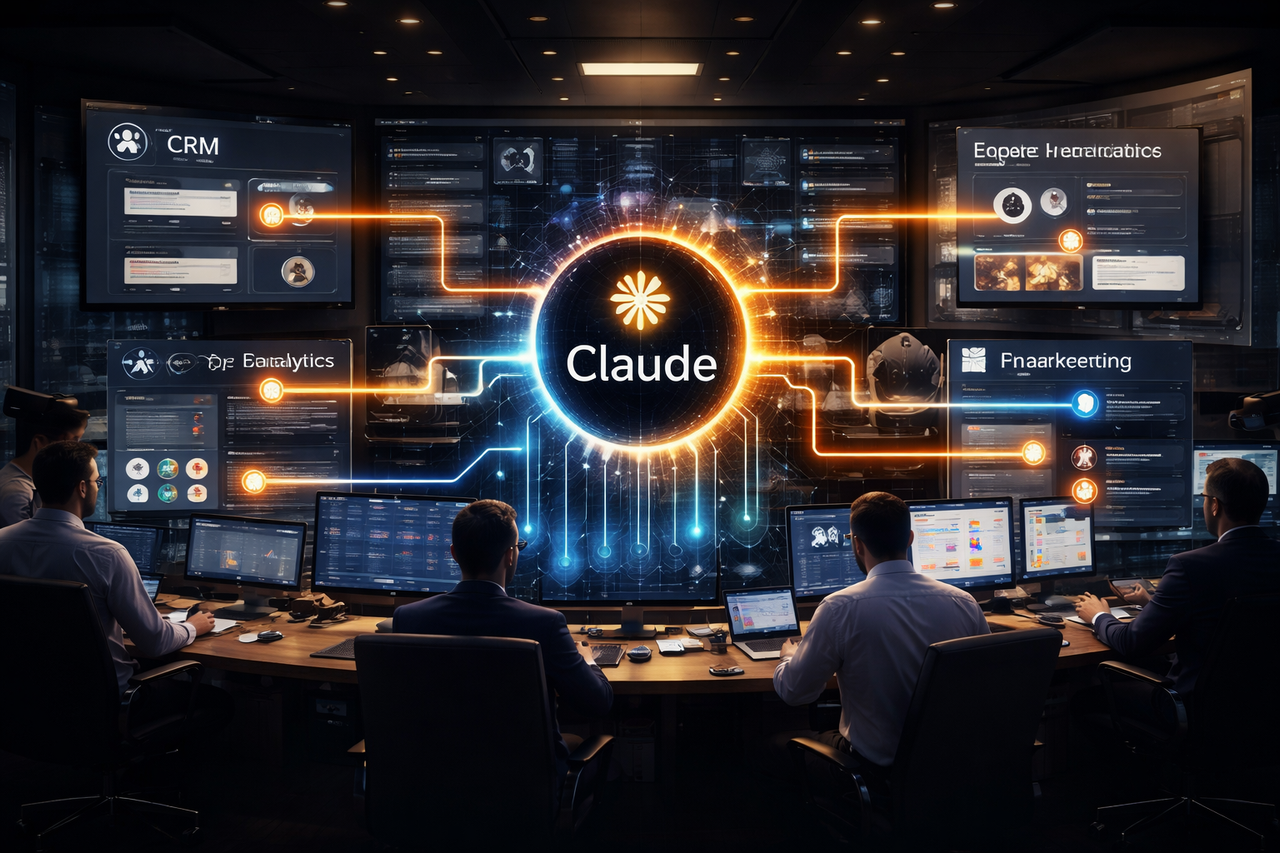
Dashboards show what happened. AI operations systems decide and act on what should happen next. This shift is redefining how companies run their day to day operations.

LLMs are powerful, but prompts alone do not create business impact. Real value comes from embedding LLMs into workflows that connect data, decisions, and actions across systems.


