



ai-automation
Autonomous Workflows. AI That Runs Operations
Autonomous workflows allow AI to coordinate tasks, decisions, and actions across systems. This shift moves businesses from manual processes to intelligent, self-operating workflows.

This article explores how SMBs are outperforming enterprise organizations in 2026 by embedding AI-driven workflows across their operations. It explains how combining AI, intelligent automation, and no-code platforms allows small teams to scale capacity, accelerate decision-making, and compete effectively without increasing headcount.
The conventional wisdom about business scaling has inverted. For decades, enterprise organizations enjoyed structural advantages: deeper pockets, larger teams, established infrastructure, and access to cutting-edge technology. Yet in 2026, something remarkable is happening. Small and medium-sized businesses (SMBs) are outpacing their larger competitors in speed, innovation, and operational efficiency.
This isn't luck. It's the direct result of a fundamental shift in how organizations approach digital transformation. The companies winning today aren't those with the biggest budgets—they're the ones who've mastered AI-driven workflows combined with intelligent automation and no-code platforms.
The data tells a compelling story. Organizations implementing AI-augmented workflows report reducing task estimation time by 50%, accelerating product launches by 3x, and scaling operational capacity without proportional headcount increases. For SMBs operating with lean resources, these improvements represent the difference between survival and market dominance.
Before diving into implementation, we need to clarify what "AI-driven workflows" actually means—because the term gets misused frequently in technology marketing.
AI-driven workflows aren't simply automating repetitive tasks. That's traditional automation, and while valuable, it's insufficient for the competitive advantages we're discussing. True AI-driven workflows represent something more sophisticated: the systematic integration of artificial intelligence throughout entire operational processes to augment human decision-making, eliminate bottlenecks, and create organizational capacity multiplication.
Consider a practical example. A civic media organization managing grassroots engagement campaigns faced a common problem: intake forms, campaign briefs, media planning, and approval routing consumed days of manual coordination. A single team member couldn't simultaneously manage more than a handful of campaigns without working unsustainable hours.
The traditional solution would involve hiring additional staff. The AI-driven workflow solution involved something different: automating intake form summarization using large language models, generating media plans through algorithmic analysis of historical performance data, and routing approvals through intelligent workflows that understood context and urgency. The result? One person could manage dozens of campaigns simultaneously. Capacity multiplied by 10x without adding headcount.
This example illustrates the core principle: AI-driven workflows don't replace human judgment—they eliminate the tedious analytical work that prevents humans from exercising judgment effectively.
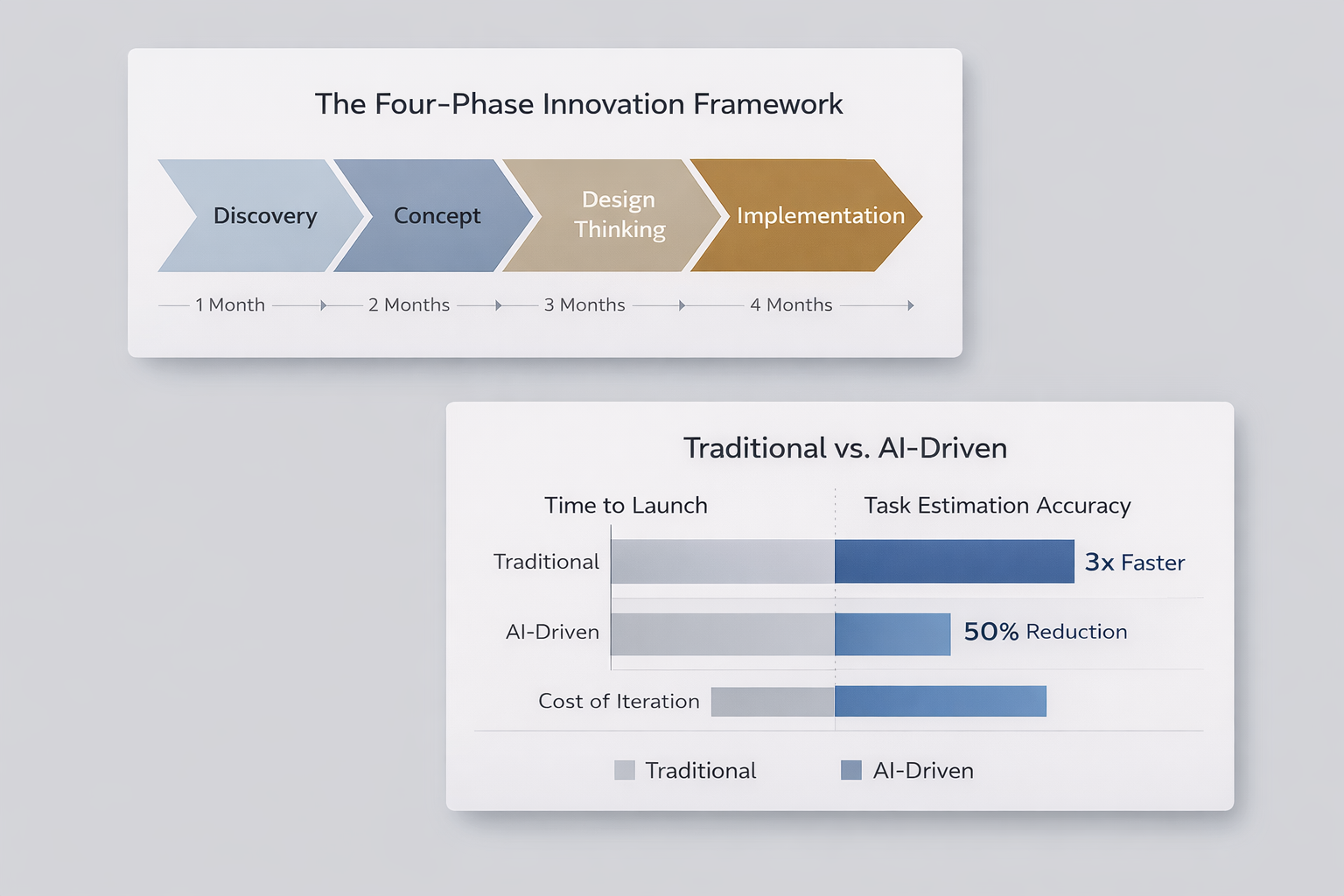
Singular Innovation's approach to building AI-driven workflows follows a structured methodology that balances speed with long-term scalability. Understanding this framework provides insight into how organizations should approach their own digital transformation initiatives.
Most organizations skip discovery or treat it as a formality. This represents a critical mistake. Discovery isn't about confirming what leadership already believes—it's about identifying genuine inefficiencies through data analysis and direct team interviews.
Effective discovery answers specific questions: Where do teams spend time on non-value-adding activities? Which processes create bottlenecks that prevent scaling? What data exists but isn't being leveraged for decision-making? Where do manual handoffs create delays?
The discovery phase typically reveals that organizations have substantially more data and operational insight than they realize. The problem isn't information scarcity—it's information fragmentation. Data exists in disconnected systems, spreadsheets, and individual team members' heads rather than in unified, accessible formats.
Once genuine problems are identified, the concept phase involves collaborative definition of scope and solution design. This phase emphasizes customization rather than applying predetermined templates.
The concept phase asks: What specific capabilities would address the identified bottlenecks? How should data flow through the system? Which processes should be automated versus which require human judgment? What integrations with existing systems are necessary?
Critically, the concept phase establishes architectural foundations that enable future evolution. Rather than optimizing exclusively for current requirements, effective concept design anticipates how the system will need to evolve as the organization grows and market conditions change.
Design thinking combines creative problem-solving with AI-driven design tools to rapidly prototype user-friendly interfaces. This phase acknowledges that user experience quality significantly impacts adoption and commercial success.
Rather than building complete systems and hoping users will adapt, design thinking involves creating multiple design iterations quickly, gathering user feedback, and refining the vision before committing to full implementation. This approach reduces the risk of building solutions that technically function but fail to achieve user adoption.
AI-powered design tools accelerate this phase substantially. What previously required weeks of designer iteration can now be accomplished in days, with AI generating initial design variations that human designers refine based on user feedback and brand requirements.
Implementation focuses on building and deploying scalable solutions using what Singular Innovation identifies as "the best no-code platforms augmented with AI automation and predictive capabilities."
The critical distinction in this phase involves building for immediate business needs while simultaneously establishing architectural foundations that accommodate future growth. This requires selecting technology platforms that offer sufficient power and flexibility to evolve as requirements change, rather than forcing premature decisions about technology stack permanence.
Implementing AI-driven workflows requires selecting appropriate technology platforms. The most common mistake organizations make involves either standardizing on a single platform for all use cases or accumulating disconnected point solutions that create integration nightmares.
Effective technology selection follows a principle: choose tools based on specific project requirements rather than vendor relationships or internal standardization preferences.
Airtable functions as the central nervous system for many AI-driven workflow implementations. Rather than treating Airtable as a simple database, sophisticated implementations leverage it as what might be termed "the next-generation database"—a platform providing intuitive user interfaces for business users while maintaining sufficient power for developer implementations.
Airtable's integrated AI capabilities, combined with external large language models like GPT-4 and Claude, enable sophisticated automation. Tasks can be submitted as user stories, validated by AI agents that assess feasibility and identify complications, estimated against internal benchmarks through algorithmic analysis, and approved through transparent quality assurance workflows.
The power of Airtable in AI-driven workflows emerges from its flexibility. It can serve as a project management system, a CRM, an operations hub, a data warehouse, or a custom application backend—often simultaneously. This flexibility allows organizations to build unified operational systems rather than accumulating disconnected tools.
FlutterFlow enables teams to ship production-grade applications across web, iOS, and Android platforms substantially faster than traditional native development approaches. When combined with AI integration, FlutterFlow becomes a platform for building sophisticated user experiences without requiring extensive custom code.
The platform's visual development approach democratizes application development, allowing product managers and designers to contribute directly to application development rather than serving as intermediaries between business requirements and technical implementation.
Beyond Airtable and FlutterFlow, effective implementations often incorporate:
Bubble for rapid web application development when FlutterFlow isn't optimal
Webflow for marketing websites and web applications requiring sophisticated design
Firebase and Supabase for backend infrastructure and real-time data synchronization
Make.com (formerly Integromat) for workflow automation across disconnected systems
Custom code (React, Node.js, Flutter native) for scenarios requiring specialized functionality or performance optimization
The principle remains consistent: select technologies based on project requirements rather than attempting to standardize on a single platform for all use cases.
The most significant competitive advantage in 2026 emerges from systematic AI integration throughout workflows rather than treating AI as an exotic add-on feature.
Intelligent automation goes beyond traditional automation by incorporating decision-making capabilities. Rather than simply executing predetermined steps, intelligent automation can evaluate context, assess multiple options, and select optimal approaches based on historical patterns and current conditions.
In practice, this means:
Intake processing: AI summarizes intake forms into structured briefs, extracting key information and flagging potential complications
Planning and estimation: AI analyzes historical project data to generate realistic timelines and resource requirements
Quality assurance: AI identifies potential issues before they reach production, reducing manual testing requirements
Approval routing: AI understands organizational context and routes approvals to appropriate stakeholders based on decision criteria
Organizations implementing intelligent automation report 50% reductions in task estimation and quality assurance time—improvements that directly impact delivery velocity and organizational productivity.
Beyond automation, AI excels at identifying patterns in data that humans would miss or require substantial time to discover. This capability transforms how organizations make decisions.
Consider a retail organization implementing AI-driven inventory forecasting. Rather than relying on manual analysis or simple statistical models, AI systems analyze historical sales patterns, seasonal trends, external factors (weather, events, economic indicators), and supply chain dynamics to generate sophisticated forecasts. The result: 30% reduction in stockouts and 20% reduction in excess inventory.
Large language models have matured to the point where they can generate initial content drafts, summarize complex information, and assist with communication tasks. While human judgment remains essential for final decisions, AI-assisted content generation accelerates workflows substantially.
In customer support contexts, AI-powered chatbots handle routine inquiries, freeing human support staff to focus on complex issues requiring genuine problem-solving. Organizations implementing AI chatbots report 40% reductions in support ticket volume and improved customer satisfaction through faster response times.

AI-driven workflows multiply operational capacity without proportional growth in team size.
A sophisticated aspect of AI-driven workflow implementation involves recognizing that organizations' technical needs evolve as business models mature and market traction validates product-market fit.
Rather than forcing organizations into technology lock-in relationships, effective implementation partners structure engagements to enable evolution across a spectrum of approaches:
Validation Phase: Start fast with no-code and low-code platforms for rapid MVP development and market validation
Growth Phase: Transition heavy-load features to custom code as adoption grows and performance requirements increase
Optimization Phase: Introduce AI workflows and automation for scalability and operational efficiency
Enterprise Phase: Maintain and optimize integrations for performance, expand into enterprise-grade development with ongoing support
This pathway acknowledges that optimal architecture at launch differs substantially from optimal architecture at scale. By structuring engagements to enable evolution rather than forcing premature technology decisions, organizations position themselves for sustainable growth.
The theoretical advantages of AI-driven workflows become concrete when examining actual organizational results.
A civic media organization managing grassroots engagement campaigns faced capacity constraints. Manual processes limited the organization to managing a handful of campaigns simultaneously. By implementing an AI-driven workflow platform built with Airtable and FlutterFlow:
Campaign capacity increased from 5-10 simultaneous campaigns to 50+
Time spent on administrative coordination decreased from 60% to 15% of team time
Campaign launch time decreased from 5-7 days to 1-2 days
Team size remained constant despite 10x capacity increase
A retail organization implemented AI-driven inventory forecasting:
Stockout incidents decreased by 30%
Excess inventory decreased by 20%
Working capital tied up in inventory decreased by 15%
Forecast accuracy improved from 65% to 88%
A SaaS company implemented AI-powered customer support workflows:
Support ticket volume decreased by 40% through AI chatbot handling of routine inquiries
Average response time decreased from 4 hours to 15 minutes
Customer satisfaction scores increased by 25%
Support team productivity increased by 60% (same team handling 2.5x ticket volume)
These results aren't exceptional—they represent typical outcomes from well-implemented AI-driven workflows. Organizations that haven't yet implemented these approaches are systematically disadvantaging themselves relative to competitors who have.
A critical misconception about AI-driven workflows involves the assumption that they inevitably displace human roles. This perspective misunderstands both AI capabilities and organizational dynamics.
AI excels at specific tasks: analyzing large datasets, identifying patterns, executing predetermined steps, and generating initial content. AI struggles with tasks requiring genuine creativity, complex judgment under uncertainty, relationship management, and understanding of human preferences and values.
Effective AI-driven workflows augment human capabilities rather than replacing them. By automating tedious analytical work and routine decisions, AI frees humans to focus on activities where human judgment creates genuine value.
Consider a product development team. Rather than spending 40% of time on project estimation and status tracking, team members could spend that time on creative problem-solving, user research, and strategic thinking. The AI handles the analytical work; humans handle the judgment.
This distinction proves critical for organizational adoption. Teams that view AI as a tool to eliminate their roles resist implementation. Teams that view AI as a tool to eliminate tedious work and focus on higher-value activities embrace it enthusiastically.
While AI-driven workflows offer substantial benefits, implementation involves genuine challenges that organizations should anticipate.
AI systems depend on high-quality, integrated data. Organizations with fragmented data across disconnected systems face substantial challenges. Addressing this requires:
Conducting a data audit to understand current state
Establishing data governance standards
Implementing data integration and cleansing processes
Creating single sources of truth for critical business information
Technology implementation fails when organizations underestimate change management requirements. Teams accustomed to existing processes resist new workflows, particularly when they don't understand the rationale for change.
Effective change management involves:
Clear communication about why changes are necessary
Involving teams in design and implementation decisions
Providing comprehensive training and support
Celebrating early wins and demonstrating value
Addressing concerns and resistance directly
Organizations in regulated industries face legitimate concerns about security and compliance implications of AI-driven workflows. Addressing these requires:
Implementing encryption for data in transit and at rest
Establishing role-based access controls
Conducting security audits and penetration testing
Ensuring compliance with applicable regulations (HIPAA, GDPR, CCPA, etc.)
Maintaining audit trails for regulatory compliance
Implementing AI-driven workflows requires skills that many organizations lack internally. Addressing this involves:
Partnering with experienced implementation firms
Investing in team training and development
Building internal expertise gradually
Creating documentation and knowledge bases for sustainability
The convergence of three factors in 2026 creates a genuine competitive imperative for AI-driven workflows:
AI Maturity: Large language models and machine learning capabilities have matured to the point where they deliver genuine business value rather than serving as experimental technologies
Platform Accessibility: No-code and low-code platforms have evolved to support sophisticated implementations previously requiring extensive custom development
Market Pressure: Organizations that haven't implemented these approaches are systematically losing competitive advantage to those who have
This convergence creates a window of opportunity. Organizations that implement AI-driven workflows now will establish competitive advantages that become increasingly difficult for competitors to overcome. Organizations that delay will find themselves playing catch-up against competitors with established capabilities and organizational muscle memory around these approaches.
For organizations ready to implement AI-driven workflows, a practical roadmap involves:
Conduct a rapid assessment to identify processes where AI-driven workflows would deliver the highest impact. Look for:
Processes consuming substantial team time
Processes involving repetitive analytical work
Processes creating bottlenecks that prevent scaling
Processes where data exists but isn't being leveraged
Before implementation, establish clear metrics for success:
Time savings (hours per week/month)
Capacity improvements (volume handled without headcount increase)
Quality improvements (error rates, customer satisfaction)
Cost savings (direct and indirect)
Work with implementation partners to design the solution architecture:
Map current workflows
Identify automation opportunities
Design new workflows incorporating AI capabilities
Plan technology stack and integrations
Build the solution in phases, starting with core functionality and expanding based on learnings:
Implement core workflows
Gather user feedback
Refine based on feedback
Expand to additional processes
Continuously measure results against established metrics and optimize based on learnings:
Track time savings and capacity improvements
Identify additional optimization opportunities
Refine workflows based on usage patterns
Expand to additional processes
The organizations winning in 2026 aren't distinguished by their size or resources—they're distinguished by their willingness to embrace new approaches and their capability to implement them effectively.
AI-driven workflows represent more than a technological upgrade. They represent a fundamental shift in how organizations approach operational efficiency, scalability, and competitive positioning. By systematically integrating artificial intelligence throughout workflows, organizations can achieve capacity multiplication, accelerate decision-making, and focus human talent on activities where human judgment creates genuine value.
The competitive advantage won't last forever. As AI-driven workflows become standard practice, the advantage will shift to organizations that implement them most effectively and continue innovating beyond them. But for the next 18-24 months, organizations that implement these approaches now will establish competitive advantages that become increasingly difficult for competitors to overcome.
The question isn't whether your organization should implement AI-driven workflows. The question is how quickly you can implement them before your competitors do.
AI-driven workflows multiply organizational capacity without proportional headcount increases through intelligent automation and data integration
The four-phase innovation framework (Discovery, Concept, Design Thinking, Implementation) balances speed with long-term scalability
Strategic technology selection based on project requirements rather than vendor standardization enables sophisticated implementations
AI augments human capabilities rather than replacing them, freeing teams to focus on high-value activities
Real-world results demonstrate 3x faster launches, 50% reduction in estimation time, and 10x capacity improvements
Implementation challenges around data quality, change management, and security are addressable through systematic approaches
The competitive window is now—organizations implementing AI-driven workflows in 2026 establish advantages that become increasingly difficult to overcome
Building AI Agents with Airtable and n8n
This article was developed with the assistance of AI tools and reviewed by the Singular Innovation team for accuracy and context.
Autonomous workflows allow AI to coordinate tasks, decisions, and actions across systems. This shift moves businesses from manual processes to intelligent, self-operating workflows.

Dashboards show what happened. AI operations systems decide and act on what should happen next. This shift is redefining how companies run their day to day operations.

LLMs are powerful, but prompts alone do not create business impact. Real value comes from embedding LLMs into workflows that connect data, decisions, and actions across systems.


