



ai-automation
Autonomous Workflows. AI That Runs Operations
Autonomous workflows allow AI to coordinate tasks, decisions, and actions across systems. This shift moves businesses from manual processes to intelligent, self-operating workflows.
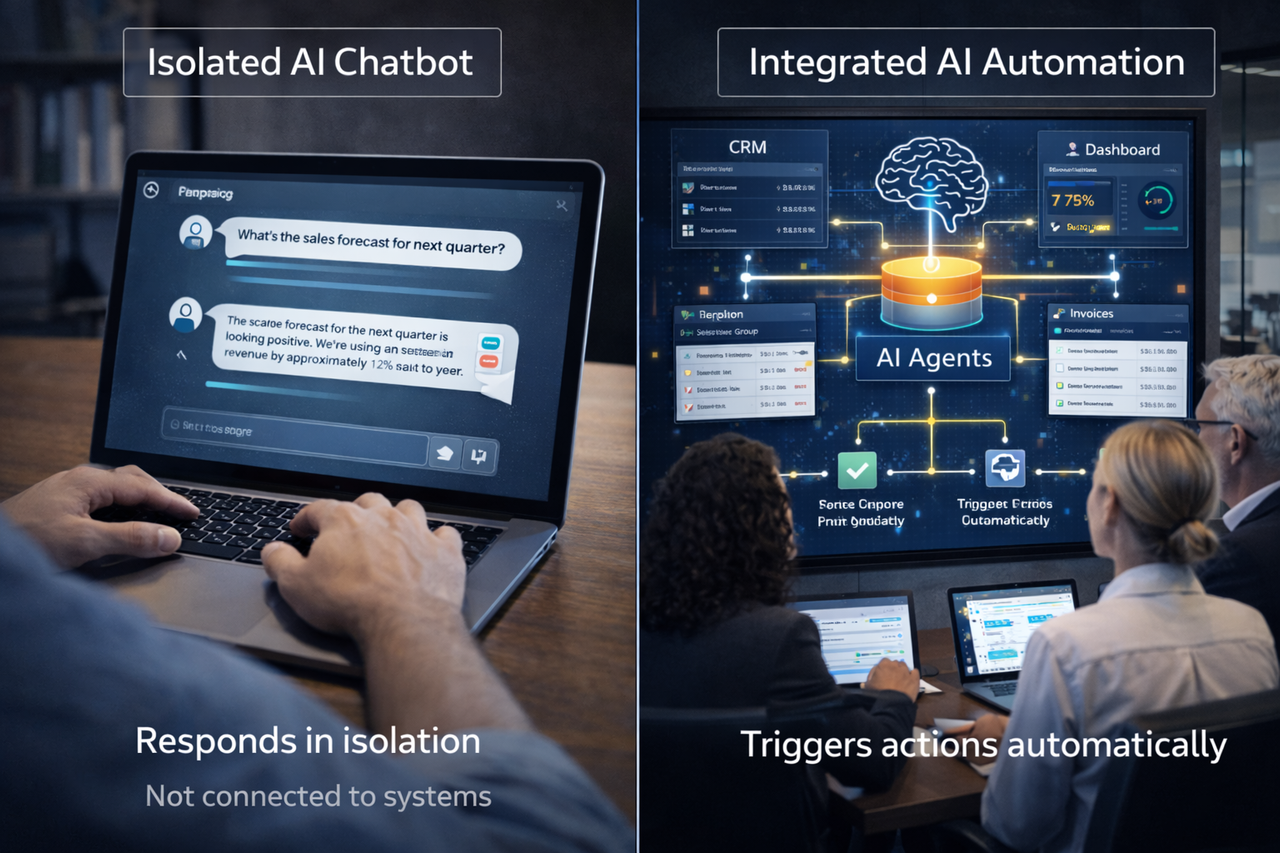
Most AI initiatives never move beyond experiments. Real value appears when AI becomes part of operational workflows. This article explains why AI projects fail and how companies can build real automation systems.
Artificial intelligence has moved from research labs into everyday business conversations. Every week companies announce new AI pilots, prototypes, and internal tools powered by large language models.
Yet something surprising happens after the excitement fades.
Most AI projects never reach production.
They remain experiments. Internal demos. Small pilot programs that never scale into operational systems.
Executives begin asking a difficult question. If AI is so powerful, why does it rarely transform day to day operations?
The answer is simple but uncomfortable.
Most organizations treat AI as a feature instead of an operational system.
Real value from artificial intelligence appears only when AI becomes part of business workflows. Not when it exists as a disconnected tool.
Understanding this difference explains why so many AI initiatives stall before reaching meaningful impact.
Many companies begin their AI journey in the same way.
A team builds a chatbot.
Someone experiments with prompt engineering.
A department tests a tool that generates reports or summarizes documents.
These experiments can be impressive.
They demonstrate what AI is capable of. They show how quickly models can analyze data, generate content, or answer questions.
But experiments rarely solve operational problems.
The moment a team tries to integrate the experiment into daily work, several challenges appear.
The AI tool cannot access company data reliably.
It is disconnected from the systems employees actually use.
It cannot trigger actions across applications.
Instead of becoming part of operations, the tool becomes another isolated interface.
Employees continue working the way they always have.
The AI experiment remains exactly that. An experiment.
According to research from the Boston Consulting Group, more than 70 percent of AI transformation initiatives struggle to deliver measurable business impact because they fail to integrate with operational processes.
Reference
https://www.bcg.com/publications/2023/why-ai-transformations-fail
The problem is rarely the model itself.
The problem is architecture.
Most organizations adopt AI as a tool.
They deploy chat interfaces. They experiment with assistants. They test models that generate text or analyze data.
Tools can be useful. But tools alone rarely change how companies operate.
Operational impact requires systems.
An AI system connects three essential layers.
Knowledge
Data and institutional knowledge that the AI can access and understand.
Workflow
Operational processes that structure how work is performed.
Action
The ability to trigger actions across applications and systems.
Without these three layers working together, AI remains passive.
It can answer questions. It cannot run operations.
Real automation begins when AI systems become embedded inside workflows rather than sitting outside them.
Moving from experimentation to automation requires solving several technical and organizational problems.
Most companies underestimate how complex this transition can be.
Business information is rarely centralized.
Customer data lives in a CRM. Financial data sits in accounting systems. Documents are scattered across drives and internal tools.
AI systems cannot operate effectively if they cannot access structured information.
Creating reliable data pipelines becomes the first challenge.
Modern companies rely on dozens of SaaS tools.
Marketing platforms. Project management systems. Customer support tools. Analytics dashboards.
These tools rarely communicate with each other without custom integrations.
For AI to automate work, it must interact with multiple systems simultaneously.
This requires integration layers capable of orchestrating actions across applications.
Many organizations do not have clearly defined workflows.
Tasks are performed through informal processes. Decisions rely on human judgment rather than structured systems.
AI cannot automate processes that are not clearly defined.
Before automation becomes possible, workflows must be mapped, standardized, and instrumented.
Operational systems must be reliable.
When AI begins influencing business decisions, companies must establish governance frameworks. This includes monitoring outputs, controlling permissions, and ensuring compliance.
Without these safeguards, leadership teams hesitate to trust automation.
This slows adoption dramatically.
To move beyond experimentation, organizations need a different architecture.
Instead of focusing on individual AI tools, companies must build AI operational infrastructure.
This infrastructure typically includes several components.
Large language models and specialized AI systems provide reasoning, analysis, and decision support.
These models interpret information, generate insights, and recommend actions.
AI must access structured and unstructured knowledge.
This can include documents, databases, internal systems, and operational records.
Technologies such as vector databases and retrieval systems allow AI to reason over business knowledge.
Workflows define how tasks move through an organization.
An AI automation system must understand these processes and coordinate tasks across departments and systems.
This is where automation platforms and orchestration engines become essential.
The final step is execution.
AI systems must be able to trigger actions across applications. Updating records. Generating reports. Sending notifications. Launching processes.
Without an action layer, AI remains analytical rather than operational.
A new category of technology is emerging to address these challenges.
Instead of isolated AI tools, companies are beginning to deploy AI automation engines.
These platforms connect models, workflows, and business systems into a unified operational layer.
An automation engine can coordinate tasks across multiple applications, monitor operational signals, and execute actions automatically.
In this model, AI does not simply answer questions.
It participates directly in operations.
Systems observe business data, interpret signals, and trigger workflows that move work forward.
This shift represents the next phase of enterprise AI adoption.
Interestingly, small and mid sized businesses may be better positioned to operationalize AI than large enterprises.
Large organizations often struggle with legacy infrastructure and complex governance layers.
SMBs operate with fewer constraints.
They can redesign workflows more quickly. They can adopt integrated systems rather than patching together legacy tools.
With modern platforms and integration technologies, SMBs can build AI enabled operational systems much faster than traditional enterprises.
This creates a significant competitive opportunity.
Companies that move quickly can automate processes, reduce operational friction, and scale productivity without proportional increases in headcount.
Artificial intelligence will not transform business simply because models become more powerful.
Transformation occurs when AI becomes embedded in the operational fabric of companies.
The organizations that succeed will move beyond experimentation.
They will build systems that integrate knowledge, workflows, and execution.
These systems will coordinate tasks, surface insights, and automate routine processes.
Employees will not interact with AI only through chat interfaces.
Instead, AI will quietly support operations behind the scenes.
Monitoring signals. Triggering workflows. Coordinating systems.
In other words, AI will evolve from a tool into an operational infrastructure.
The gap between AI experimentation and AI transformation is not about model capability.
It is about operational design.
Companies that continue experimenting with isolated tools will struggle to generate real business value.
Organizations that build integrated automation systems will unlock the true potential of artificial intelligence.
The future of AI in business is not about better prompts.
It is about building operational systems where intelligence, workflows, and actions work together.
That is when automation becomes real.
• McKinsey. AI & Advanced Analytics Insights
https://www.mckinsey.com/capabilities/quantumblack/our-insights
• IBM. Automation
https://www.ibm.com/topics/automation
• OpenAI
https://openai.com
Many companies experiment with AI but struggle to operationalize it.
Most companies stay stuck in AI pilots.
Real impact comes when AI becomes part of your operations.
At Singular Innovation, we help SMBs design and implement AI automation systems that connect workflows, data, and actions. Without heavy engineering.
If you're exploring how to turn AI into real business impact:
Schedule a free discovery call
https://app.iclosed.io/e/singularagency/schedule-a-discovery-call
This article was developed with the assistance of artificial intelligence tools to support research, structure, and editorial drafting. All strategic analysis, validation, and final editorial review were conducted by the Singular Innovation team.
Autonomous workflows allow AI to coordinate tasks, decisions, and actions across systems. This shift moves businesses from manual processes to intelligent, self-operating workflows.

Dashboards show what happened. AI operations systems decide and act on what should happen next. This shift is redefining how companies run their day to day operations.

LLMs are powerful, but prompts alone do not create business impact. Real value comes from embedding LLMs into workflows that connect data, decisions, and actions across systems.


