



ai-automation
Autonomous Workflows. AI That Runs Operations
Autonomous workflows allow AI to coordinate tasks, decisions, and actions across systems. This shift moves businesses from manual processes to intelligent, self-operating workflows.

Rigid software retainers inflate burn and create restart costs. A flexible development agency model helps US mid-market B2B companies scale velocity up or down while preserving continuity and protecting capital.
In the United States mid-market B2B sector, software velocity is often treated as a proxy for performance.
Burn charts are tracked weekly. Sprint velocity becomes a KPI. Feature throughput is used to demonstrate progress to boards, investors, and enterprise stakeholders.
But velocity without adaptability becomes operational risk.
Across US mid-market B2B companies, a structural tension persists between rigid agency contracts and nonlinear business cycles. When development pace is contractually fixed but business conditions shift, organizations fall into what we call the Velocity Trap.
The Velocity Trap occurs when a company is locked into a high software development burn rate even when market validation, capital strategy, or customer feedback requires deceleration.
For CFOs, COOs, and product leaders, this misalignment directly impacts capital efficiency and execution stability.
True agility is not about moving fast.
It is about adjusting speed without losing continuity.

Flexible software development agency model aligned with US mid-market B2B capital efficiency and operational agility
The Velocity Trap is a contractual and operational misalignment between development speed and business reality.
It typically emerges in three phases:
A company accelerates toward:
• MVP launch
• Enterprise pilot
• Investor milestone
• Industry conference release
Velocity is high. Team allocation is full. Burn rate increases.
After launch, reality introduces friction:
• Unexpected user behavior
• Integration issues
• Compliance requirements
• Investor scrutiny
The business must pause to:
• Validate assumptions
• Refine onboarding
• Secure funding
• Reallocate budget
In rigid agency models, the Gap becomes financially inefficient.
The company must either continue paying for full allocation or terminate the relationship entirely.
This binary choice, burn cash or burn the bridge, defines the Velocity Trap.
Most software development agencies operate under:
• Time and Materials agreements
• Fixed scope contracts
• Dedicated team retainers
All three models prioritize allocation stability.
However, mid-market B2B companies operate under financial discipline. EBITDA expectations, quarterly forecasts, and enterprise sales cycles require operational flexibility.
According to McKinsey research on agile procurement and vendor flexibility, organizations that fail to structure adaptive supplier relationships incur higher total costs due to stop-and-go inefficiencies and structural rigidity:
https://www.mckinsey.com/capabilities/operations/our-insights/better-for-cost-talent-and-customer-agile-procurement-at-a1-telekom-austria-group
When development speed does not match business needs, companies experience:
• Artificial feature expansion
• Misaligned roadmap prioritization
• Capital erosion
• Increased risk exposure
For US mid-market B2B firms, this directly affects valuation and investor confidence.
When rigid contracts force termination during a strategic pause, companies face a restart tax.
Research from Harvard Business Review demonstrates that team familiarity significantly improves performance, execution speed, and communication efficiency:
https://hbr.org/2013/12/the-hidden-benefits-of-keeping-teams-intact
Disbanding a team results in:
• Loss of architectural rationale
• Context switching inefficiencies
• Re-estimation cycles
• Morale degradation
• Delayed roadmap recovery
For B2B software companies serving enterprise clients in the United States, execution stability is not optional. It is foundational to customer retention and revenue predictability.
Restarting development three months later does not resume at prior velocity. It begins below baseline.
This restart tax compounds over time.
A flexible software development agency model treats velocity as adjustable capacity rather than fixed allocation.
Instead of locking companies into a constant burn rate, elastic capacity allows development to scale up or down based on business conditions.
At Singular, this model operates through subscription-based tiers that align with real operational phases:
• High Velocity Tier for launch or scale
• Strategic Pause Tier for validation
• Ramp-Up Tier for reacceleration
This approach aligns development cadence with capital strategy.
Our philosophy of adaptive execution is also explored in:
AI-Augmented Workflows for Digital Product Development
https://www.singular-innovation.com/blog/ai-augmented-workflows-digital-product-development-framework
And in:
The Rise of Everything Apps
https://www.singular-innovation.com/blog/the-rise-of-everything-apps-a-new-era-of-seamless-experiences
Both articles reinforce a central thesis. Innovation cycles are nonlinear. Engagement models must reflect that reality.
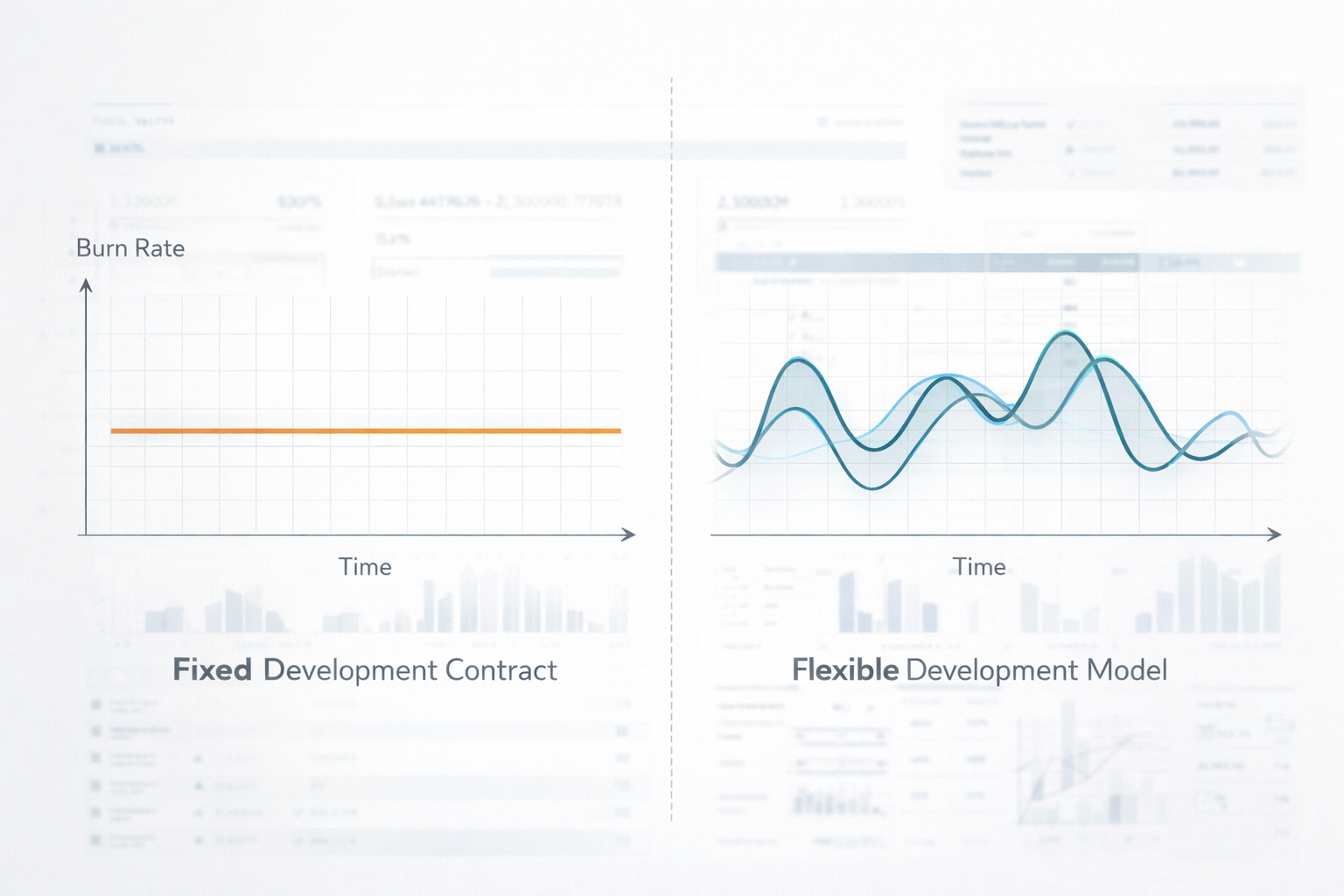
Rigid retainers increase burn rate. Flexible development models align velocity with business cycles.
In traditional agency contracts, pauses are treated as inefficiency.
In adaptive models, pauses are strategic.
During the Strategic Pause phase, US mid-market B2B companies typically focus on:
• Enterprise onboarding optimization
• Security validation
• Regulatory compliance review
• Sales enablement alignment
• Investor communications
Maintaining reduced but continuous engineering support during this phase ensures:
• Rapid bug resolution
• Architecture preservation
• Data integrity
• Executive confidence
The team remains warm.
Context remains intact.
Velocity can resume without friction.
A US fintech client completed an aggressive three-month MVP sprint.
Post-launch priorities shifted toward:
• Investor presentations
• Compliance validation
• Initial user onboarding
Rather than terminating the engagement, the client transitioned to a lower subscription tier.
Outcomes:
• Core engineers retained
• Burn rate reduced
• Capital runway extended
• Immediate ramp-up capability
No knowledge loss.
No re-onboarding friction.
No architectural drift.
This is operational elasticity in practice.
US mid-market B2B companies operate in a uniquely demanding environment:
• Enterprise sales cycles
• SOC2 compliance expectations
• Capital discipline requirements
• Board oversight
Rigid software development retainers amplify financial risk.
Flexible models reduce exposure.
For CFOs, this improves capital allocation efficiency.
For COOs, this stabilizes execution.
For product leaders, this protects roadmap continuity.
Adaptability becomes a structural advantage.

Team continuity reduces restart costs and preserves execution stability during strategic pauses.
Dedicated team retainers promise stability.
However, stability without elasticity becomes cost rigidity.
Flexible subscription-based development models offer:
• Adjustable capacity
• Preserved team continuity
• Reduced restart tax
• Alignment with business cycles
For mid-market US companies managing enterprise clients, this reduces operational volatility.
It is an engagement structure that allows companies to scale engineering capacity up or down without terminating the team, preserving continuity while aligning with business needs.
By adjusting allocation during validation or funding phases, companies avoid paying for unused capacity while maintaining architectural continuity.
Yes. Mid-market organizations benefit from balancing startup agility with enterprise accountability. Elastic capacity supports both.
No. Core engineers remain engaged. Knowledge continuity prevents degradation.
In US mid-market B2B environments, capital efficiency and execution stability determine long-term viability.
Velocity alone does not define innovation success.
Adaptability does.
A flexible software development agency model transforms velocity from a fixed cost into a strategic lever aligned with financial and operational realities.
For companies navigating enterprise growth, investor expectations, and competitive markets, elasticity is no longer optional. It is structural.
If your roadmap requires flexibility instead of rigid burn commitments, it may be time to rethink your agency model.
Schedule a free 30-minute discovery call to explore how elastic development capacity can protect your runway and support sustainable growth.
Book your free discovery call here
This article was developed with the assistance of AI tools and reviewed by the Singular Innovation team for accuracy and context.
Autonomous workflows allow AI to coordinate tasks, decisions, and actions across systems. This shift moves businesses from manual processes to intelligent, self-operating workflows.

Dashboards show what happened. AI operations systems decide and act on what should happen next. This shift is redefining how companies run their day to day operations.

LLMs are powerful, but prompts alone do not create business impact. Real value comes from embedding LLMs into workflows that connect data, decisions, and actions across systems.


