



AI Agents
AI Operations. From Dashboards to Real Execution
Dashboards show what happened. AI operations systems decide and act on what should happen next. This shift is redefining how companies run their day to day operations.
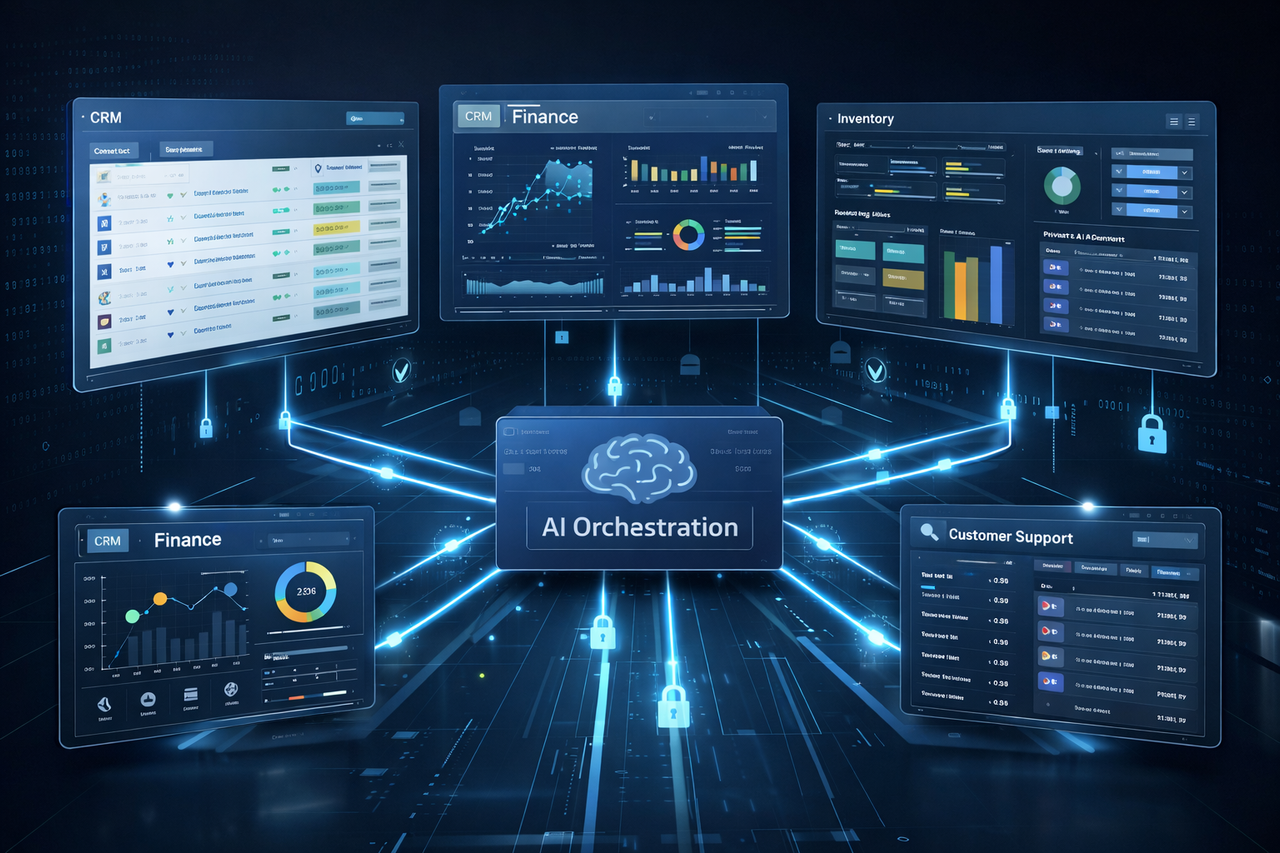
Private AI agents are reshaping how companies deploy artificial intelligence. Instead of sending sensitive data to external tools, businesses are integrating AI directly into their internal systems to improve security, automation, and operational control.
For the first wave of AI adoption, most companies experimented with public AI tools.
Teams used chatbots to write documents. Marketing departments generated content with AI assistants. Developers explored code generation tools. These experiments proved that AI could dramatically accelerate productivity.
But as companies began to integrate AI deeper into daily operations, a structural problem emerged.
Most public AI tools operate outside the company's operational environment.
Every time employees use them, company data must travel to an external platform. Internal documents, customer records, operational metrics, and proprietary knowledge all move through systems that organizations do not fully control.
For experimentation, this model works.
For operations, it becomes a risk.
This realization is driving a new architectural shift in how businesses deploy artificial intelligence. Instead of relying on external tools, companies are beginning to move AI inside their operational systems.
The result is the emergence of private AI agents. AI systems that operate within a company’s own infrastructure, connected directly to its workflows, data sources, and decision processes.
This shift may represent the most important evolution in enterprise AI adoption.

Private AI agents allow companies to integrate artificial intelligence directly into their operational systems and business workflows.
Artificial intelligence is entering a new phase of deployment.
The first phase of AI adoption focused on tools. Companies experimented with standalone applications that offered AI capabilities such as writing assistance, image generation, or coding support.
The second phase is focused on systems.
Instead of treating AI as a separate tool, organizations are embedding AI directly into their operational infrastructure.
Several technological developments are driving this transition.
First, modern AI models are becoming easier to deploy through APIs, open frameworks, and managed infrastructure providers. This makes it possible to integrate AI capabilities directly into existing applications.
Second, companies are accumulating large volumes of operational data stored across internal systems such as CRMs, project management tools, financial platforms, and customer support software.
This data is highly valuable but often remains fragmented.
Private AI agents act as a layer that connects these data sources and converts them into operational intelligence.
Third, advances in automation platforms and no-code infrastructure have lowered the technical barrier required to orchestrate complex workflows.
As a result, businesses can now design AI-driven operational systems without building massive engineering teams.
Together, these factors are creating the foundation for AI that operates inside the company rather than outside it.
Despite growing interest in AI agents, many organizations misunderstand what makes them valuable.
A common misconception is that AI adoption is primarily about accessing more powerful models.
In reality, the competitive advantage rarely comes from the model itself.
Most companies are using similar AI models through cloud providers. The difference lies in how those models are integrated into operational workflows.
Another common mistake is the belief that AI tools can simply be layered on top of existing processes without changing the underlying systems.
In practice, many AI initiatives fail because they treat AI as a productivity shortcut rather than an operational architecture.
For example, a company might deploy an AI chatbot to summarize internal documents. However, if those documents remain scattered across different systems with inconsistent formats, the AI assistant will produce unreliable outputs.
Private AI agents solve this challenge by operating directly within the systems where data already lives.
Instead of requesting information from employees, the AI can access structured operational data across the organization.
This transforms AI from a conversational assistant into an active operational component.
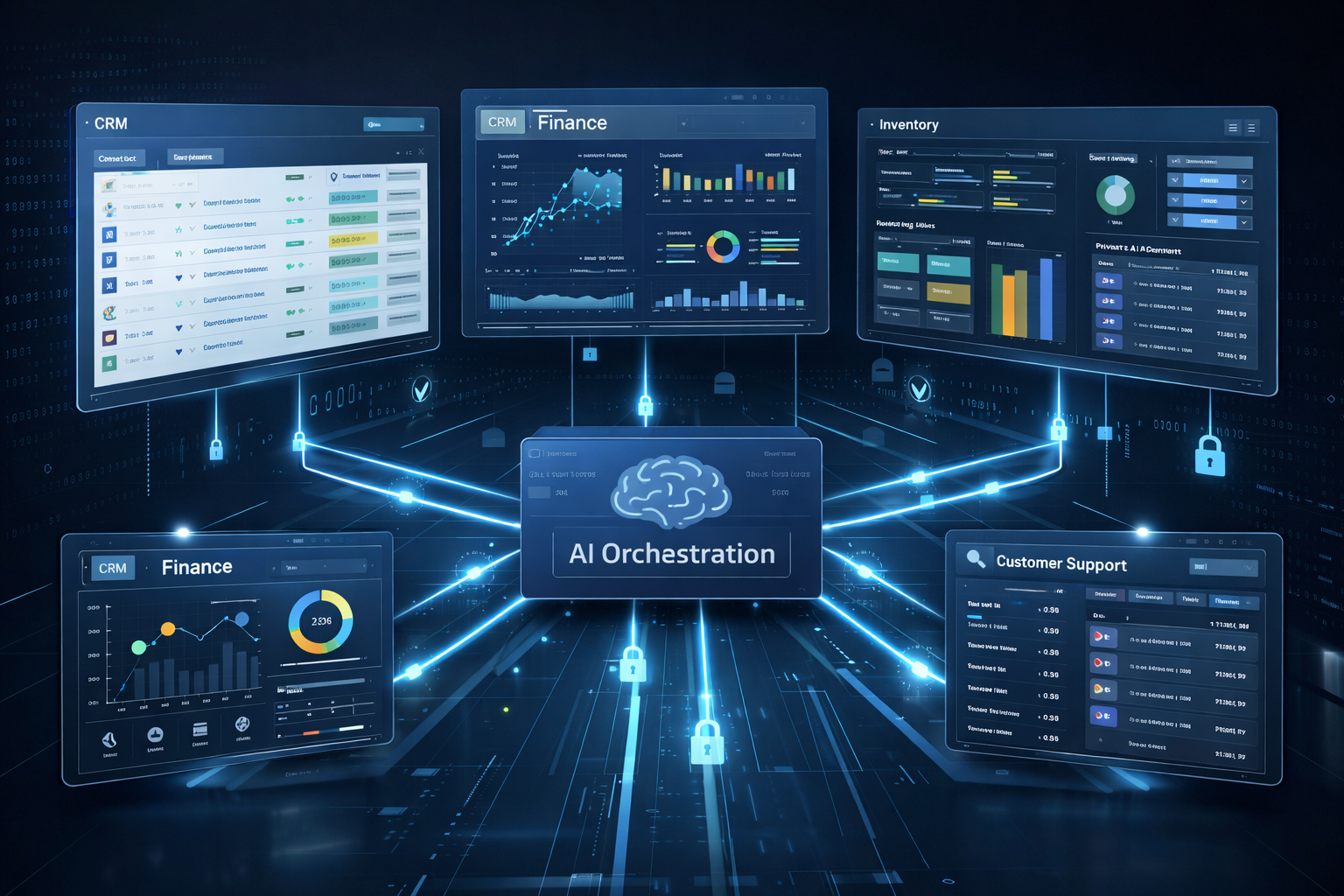
Private AI agents connect CRM, finance, inventory, and support systems into a unified operational intelligence layer.
Private AI agents operate as an intelligence layer embedded within a company’s operational stack.
Rather than functioning as standalone tools, these agents connect directly to internal systems such as:
CRM platforms
financial systems
operational databases
project management tools
product analytics platforms
At a technical level, the architecture typically includes three core layers.
The data layer
This includes all operational data sources such as customer information, sales pipelines, inventory systems, support tickets, and internal documentation.
The orchestration layer
This layer manages how information flows between systems. Automation tools, APIs, and workflow engines connect data sources and coordinate actions.
The intelligence layer
Private AI agents operate here. They analyze operational data, generate insights, and trigger automated decisions across workflows.
For example, an AI agent connected to a CRM system could automatically analyze sales activity, detect stalled opportunities, and recommend next actions for account managers.
Another agent might monitor customer support tickets and detect patterns that indicate product issues.
Because these agents operate within the company's systems, they can interact with real operational data without requiring manual input from employees.
This is what turns AI into an operational system rather than a productivity tool.
Large enterprises often struggle to implement operational AI because their systems are complex and fragmented.
Decades of legacy software, rigid governance processes, and large organizational structures make experimentation slow.
In contrast, small and mid-market businesses often have a structural advantage.
Their operational stacks are typically built from modern cloud tools. Their teams are smaller and decisions move faster.
This creates an environment where new operational models can be implemented quickly.
Private AI agents allow SMBs to create capabilities that previously required large technical teams.
For example, a small operations team could deploy AI agents that monitor key business metrics, automate reporting, and detect operational risks across multiple systems.
These capabilities allow SMBs to operate with the efficiency of much larger organizations.
The combination of AI agents and no-code infrastructure is particularly powerful because it enables teams to design intelligent workflows without writing large amounts of code.
For companies exploring private AI agents, a structured approach can significantly increase the chances of success.
Step 1. Identify operational bottlenecks
Start by mapping workflows where teams spend significant time on manual coordination, reporting, or repetitive analysis.
These processes often represent the best opportunities for AI automation.
Step 2. Connect operational systems
Ensure that core data sources are accessible through integrations or APIs.
This step is critical because AI agents rely on reliable operational data to function effectively.
Step 3. Deploy targeted AI agents
Rather than building a large AI system immediately, start with focused agents that perform specific tasks such as monitoring metrics, generating operational reports, or assisting customer support.
Step 4. Expand intelligence across workflows
Once initial agents demonstrate value, organizations can gradually extend AI capabilities across additional processes.
Over time, this creates a network of AI agents that operate across the company's operational infrastructure.
Consider a mid-size e-commerce company managing sales across several channels.
Customer orders arrive from multiple marketplaces, inventory is tracked in a warehouse management system, and customer service operates through a helpdesk platform.
In this environment, operational data exists across several disconnected systems.
A private AI agent connected to these systems could monitor order activity, inventory levels, and support tickets simultaneously.
If the system detects an increase in customer complaints about delayed shipments, the AI agent could immediately analyze inventory data and identify whether a supply issue exists.
The agent could then alert the operations team and recommend corrective actions before the issue escalates.
This type of operational awareness is difficult to achieve through manual monitoring.
Private AI agents enable businesses to create continuous intelligence across their operations.

Companies deploy private AI agents inside their infrastructure to maintain control over sensitive operational data.
Over the next five years, the architecture of business software is likely to change significantly.
Instead of organizations relying on dozens of disconnected SaaS tools, many companies will build integrated operational platforms powered by AI agents.
In these environments, AI systems will continuously analyze operational data and assist decision-making across the organization.
Several trends are likely to accelerate this shift.
First, AI models will continue to improve while becoming easier to deploy inside private infrastructure.
Second, companies will prioritize data governance and security, encouraging the development of internal AI systems rather than reliance on external tools.
Third, the rise of no-code and low-code platforms will make it easier for non-technical teams to design intelligent workflows.
The result may be a new generation of companies that operate with AI-driven operational intelligence embedded across every workflow.
Artificial intelligence is moving from experimentation to operational infrastructure.
While public AI tools introduced many companies to the potential of machine intelligence, the next phase of adoption is centered on control, integration, and operational value.
Private AI agents represent a new model in which AI operates directly within the systems that run a business.
This approach allows organizations to protect their data, connect AI to real workflows, and create continuous operational intelligence.
For many companies, the question is no longer whether to adopt AI. The real question is where that AI should live within their operational architecture.
Companies exploring how AI can move beyond experimentation into real operational systems are beginning to redesign the workflows behind their tools.
Singular Innovation helps SMBs design and build custom AI-powered operational platforms using Airtable Omni and modern no-code infrastructure.
Private AI agents operate inside a company's own systems rather than through external AI tools.
Organizations are adopting private AI to protect sensitive operational data.
The real value of AI comes from workflow integration rather than model capability alone.
Private AI agents can analyze operational data across multiple systems simultaneously.
SMBs can deploy operational AI faster than large enterprises due to lower system complexity.
AI agents can automate reporting, monitoring, and decision support across workflows.
The future of AI adoption will focus on operational platforms rather than standalone tools.
What are private AI agents?
Private AI agents are AI systems that operate within a company's own infrastructure and connect directly to internal data sources and operational workflows.
Why are companies adopting private AI systems?
Organizations want greater control over sensitive data and tighter integration between AI capabilities and their internal systems.
How are private AI agents different from public AI tools?
Public AI tools operate outside the company's environment, while private AI agents run within internal systems and access operational data directly.
Can SMBs deploy private AI agents?
Yes. Modern no-code platforms and API-based AI services allow SMBs to build operational AI systems without large engineering teams.
What business processes can AI agents automate?
AI agents can support tasks such as operational monitoring, customer service automation, sales analysis, reporting, and workflow coordination.
Private AI Agent
An AI system deployed within a company's infrastructure that interacts directly with internal data and workflows.
Operational AI
Artificial intelligence designed to support real business processes such as reporting, monitoring, and decision-making.
AI Workflow Automation
The use of artificial intelligence to automate tasks across connected business systems.
No-Code Infrastructure
Software platforms that allow users to build applications and automation without traditional programming.
Enterprise AI Control
The governance and management of AI systems within an organization's infrastructure and data environment.
McKinsey reports that 55 percent of companies are already using AI in at least one business function.
Gartner predicts that AI will influence 80 percent of enterprise software by 2028.
Deloitte research shows that organizations prioritizing AI governance achieve significantly higher returns on AI investments.
Harvard Business Review highlights that data integration is one of the biggest barriers to AI implementation.
This article was developed with the assistance of artificial intelligence tools to support research, structure, and editorial drafting. All strategic analysis, validation, and final editorial review were conducted by the Singular Innovation team.
Dashboards show what happened. AI operations systems decide and act on what should happen next. This shift is redefining how companies run their day to day operations.
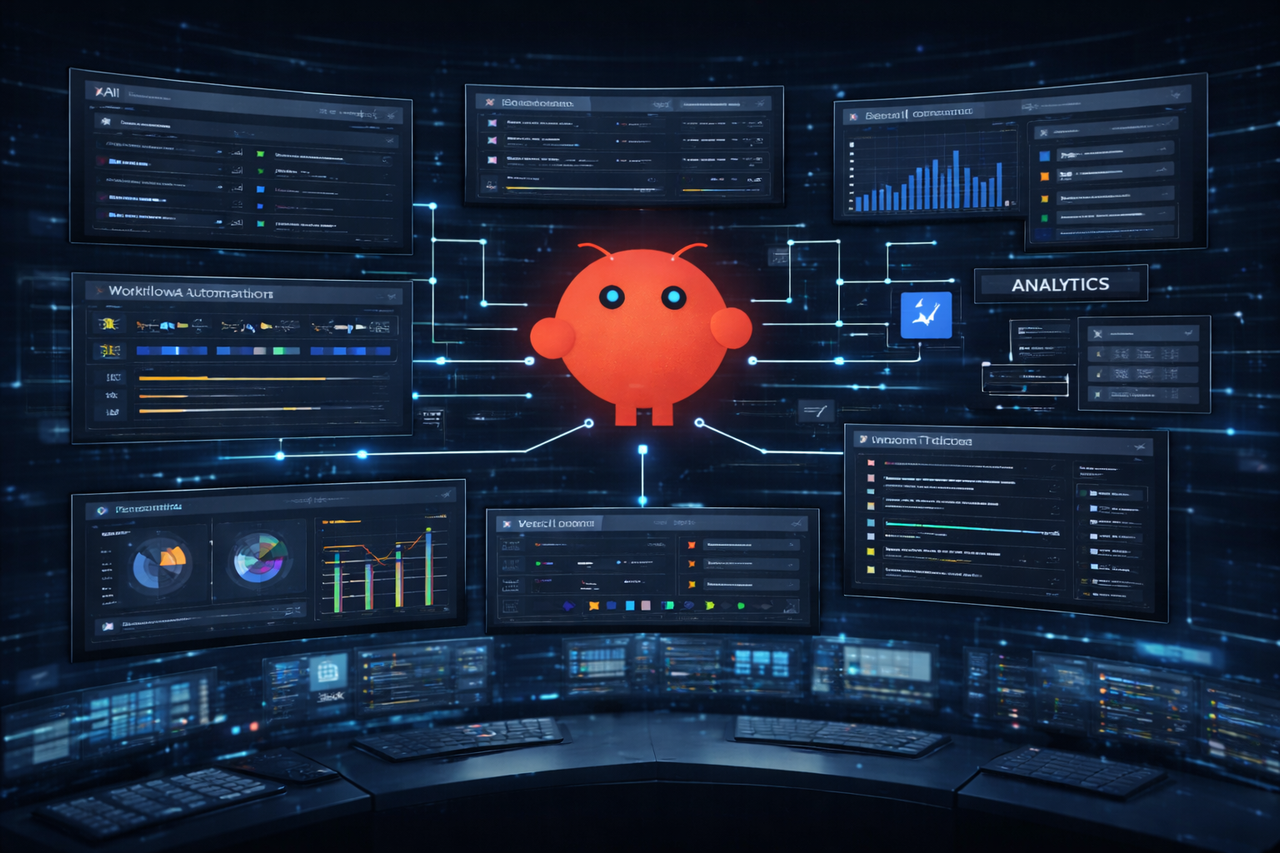
Most companies operate across disconnected tools. AI automation engines like OpenClaw unify systems, workflows, and data into one operational layer, enabling real automation, faster execution, and better decisions.
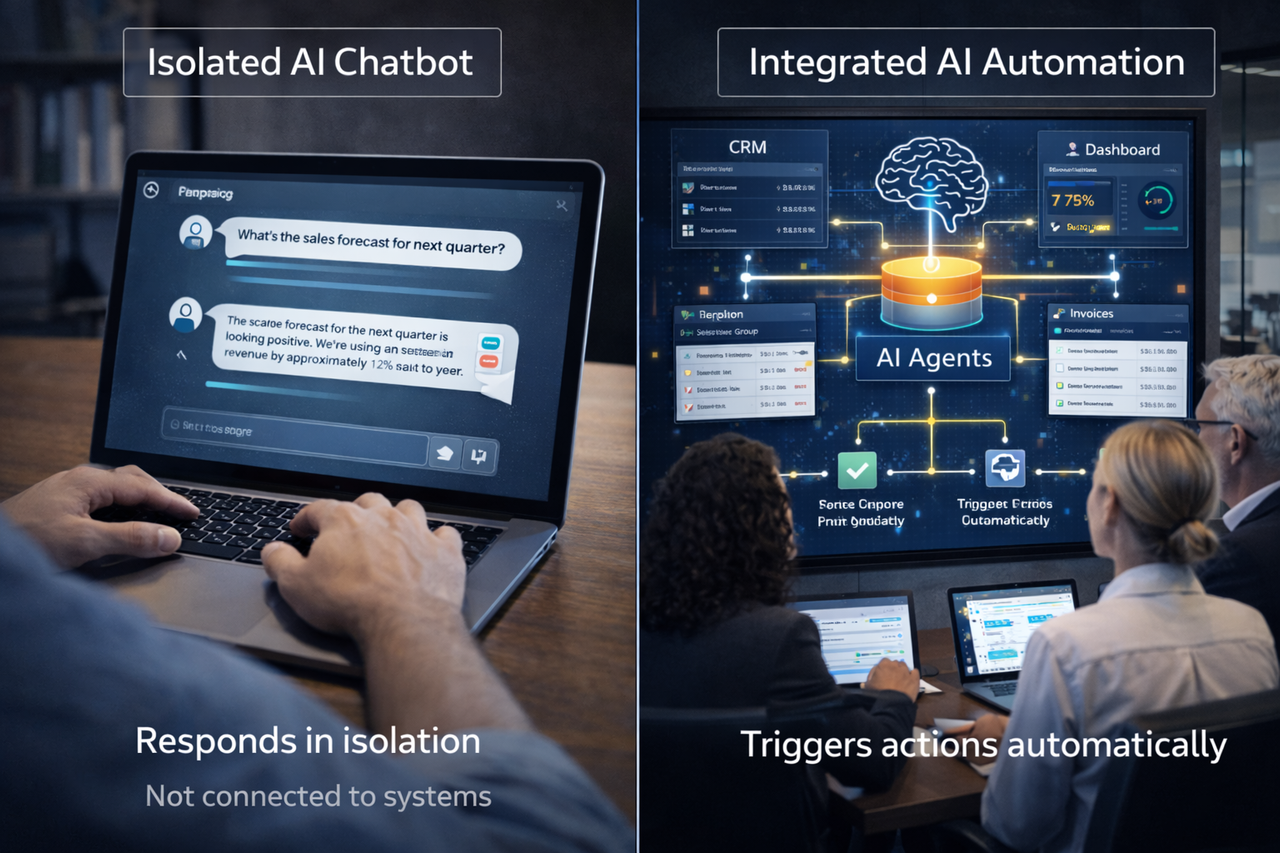
Most AI initiatives never move beyond experiments. Real value appears when AI becomes part of operational workflows. This article explains why AI projects fail and how companies can build real automation systems.


