



ai-automation
Autonomous Workflows. AI That Runs Operations
Autonomous workflows allow AI to coordinate tasks, decisions, and actions across systems. This shift moves businesses from manual processes to intelligent, self-operating workflows.

Vibe coding promises fast product development with AI-generated code, but speed without engineering discipline creates technical debt, security risks, and maintenance costs. Learn why real AI products still require structured engineering practices.
Over the past two years, a new phrase has spread rapidly across the technology world: vibe coding.
The idea is simple and appealing. Instead of writing software line by line, developers describe what they want in natural language and AI generates the code automatically.
For founders, product teams, and startups racing to build new applications, this promise is irresistible.
Why spend months building software when an AI assistant can produce working code in minutes?
Across social media and developer communities, examples appear daily. Entire applications built in a weekend. SaaS products launched in days. Complex interfaces generated with only a few prompts.
The narrative is clear.
AI has made software development almost effortless.
But behind this narrative lies a dangerous misconception.
While AI dramatically accelerates prototyping, it does not eliminate the engineering discipline required to build scalable products.
In fact, when organizations rely exclusively on vibe coding, they often create software systems that look functional on the surface but collapse under real-world demands.
The result is what many engineering teams are now encountering: the illusion of speed.
Products appear to move faster in the early stages but become dramatically slower, more expensive, and more fragile once they reach production.
Understanding this illusion is critical for founders, operators, and companies building AI-powered products.
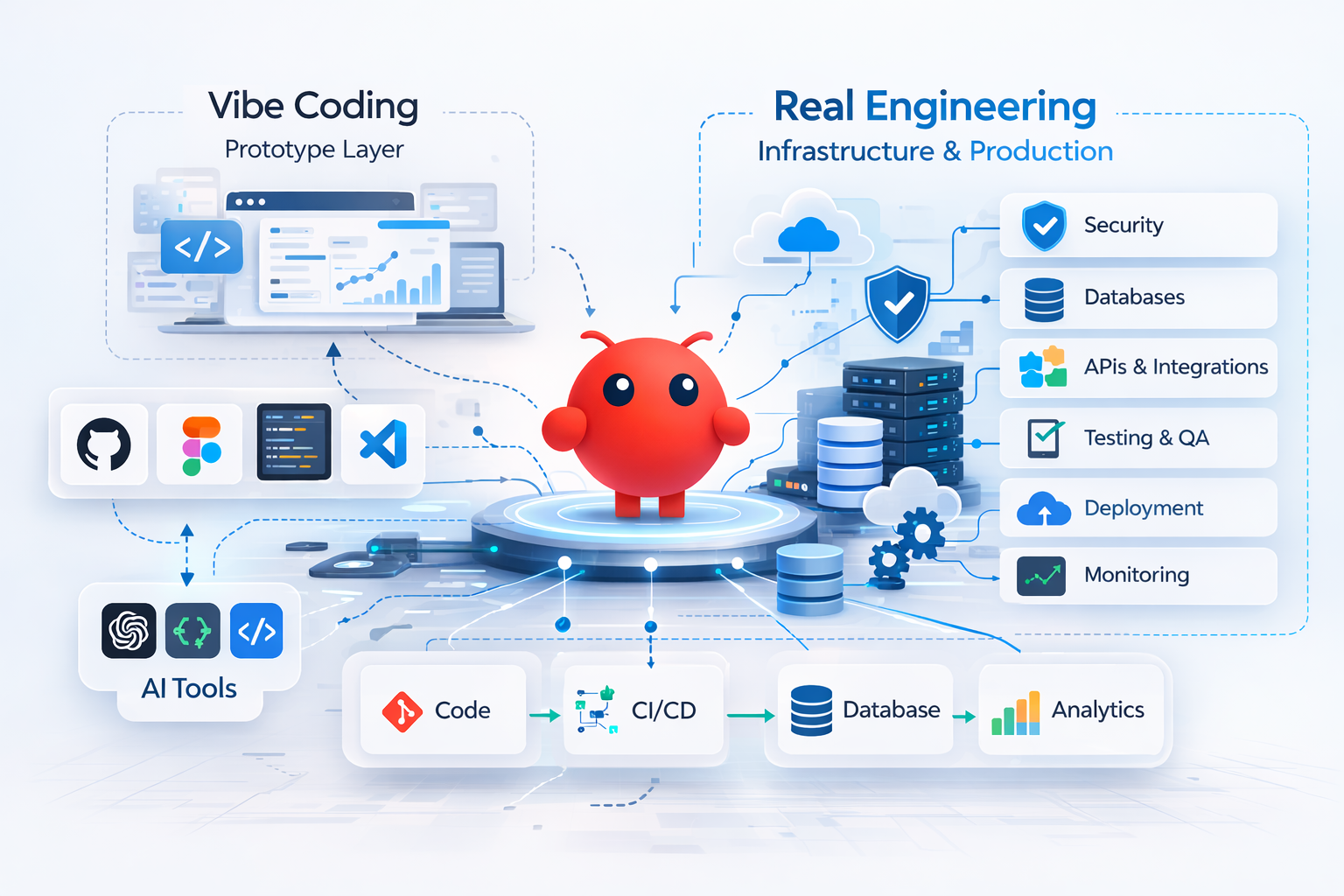
Real software engineering requires robust infrastructure including databases, security systems, deployment pipelines, and monitoring layers coordinated across the product stack.
Vibe coding represents a genuine technological breakthrough.
Modern AI models can generate code, explain algorithms, design interfaces, and even build entire application structures from simple prompts.
Developers using tools like GitHub Copilot, ChatGPT, or other AI coding assistants report significant productivity gains when generating repetitive or well-understood code.
For example, AI performs extremely well at tasks such as:
• generating API endpoints
• creating database schemas
• building basic user interfaces
• writing documentation
• scaffolding project structures
In these areas, productivity gains can be substantial.
Studies show developers may complete routine coding tasks 20–55% faster using AI assistance.
For startups and early stage products, this speed creates a powerful advantage.
Teams can test ideas quickly.
Prototypes can be built rapidly.
User interfaces can be created in hours rather than days.
From the outside, it appears that software development itself has become dramatically easier.
However, this perception only reflects the visible portion of the development process.
Software systems behave much like an iceberg.
The visible portion above the water represents the application interface and initial functionality.
Below the surface lies the majority of the engineering work required to support that system.
This hidden layer includes:
• infrastructure architecture
• database design
• performance optimization
• authentication systems
• security layers
• automated testing frameworks
• monitoring and observability tools
When developers generate code using AI prompts, they typically produce only the visible layer.
The deeper engineering infrastructure must still be designed, implemented, and maintained.
Ignoring this reality creates what many engineers call technical debt.
Technical debt accumulates when systems are built quickly without proper architecture, forcing teams to spend increasing amounts of time fixing issues later.
In AI-generated systems, this debt can accumulate rapidly.
Code generated by AI often contains redundancies, inefficient patterns, or architectural shortcuts that appear functional but create long-term maintenance challenges.
What initially feels like acceleration eventually becomes friction.
The risks associated with vibe coding extend beyond technical debt.
Research examining AI-generated code has revealed several consistent issues.
One of the most concerning findings involves security vulnerabilities.
Studies indicate that nearly half of AI-generated code snippets contain potential security risks when used without review.
Common issues include:
• improper input validation
• insecure authentication logic
• exposed API keys
• vulnerabilities to SQL injection
• cross-site scripting risks
These problems emerge because AI models reproduce patterns from training data without fully understanding security implications.
A prompt may generate working code, but not necessarily secure code.
In production environments handling sensitive customer data, financial transactions, or user authentication, these vulnerabilities become significant liabilities.
Beyond security, AI-generated code can also introduce performance inefficiencies.
Applications built quickly using generated code may perform adequately with small numbers of users but struggle when usage grows.
Database queries may be inefficient. Caching mechanisms may be absent. System architecture may not support scaling.
When these issues emerge, teams often discover that large portions of the application must be redesigned.
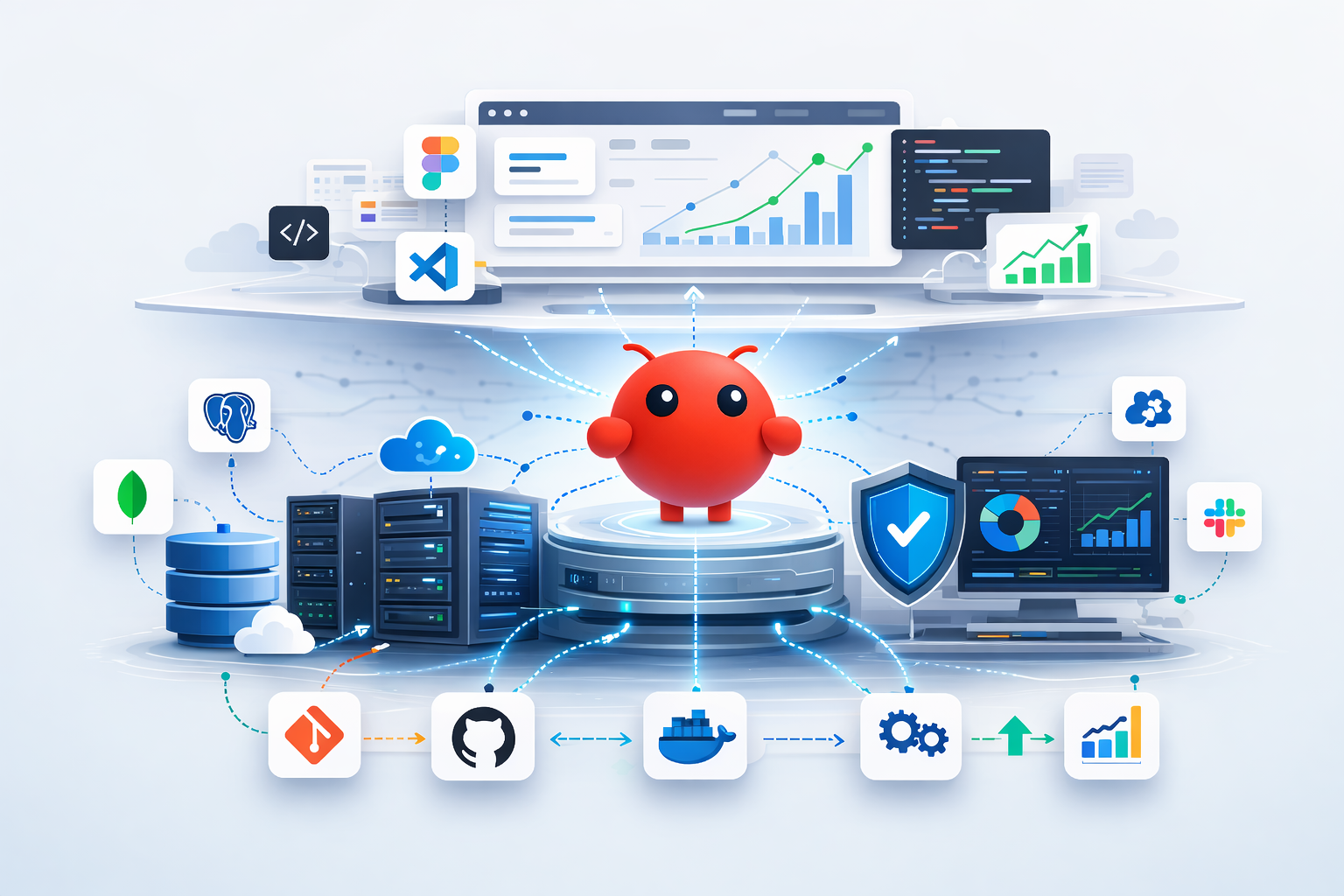
AI-assisted development becomes powerful when tools for design, coding, testing, and analytics operate within structured engineering workflows.
Another surprising discovery in recent research involves what some experts call the AI productivity paradox.
Developers frequently feel more productive when using AI tools.
Yet objective measurements sometimes show the opposite.
In controlled studies where experienced developers completed realistic programming tasks, teams using AI assistance occasionally took longer to finish compared to those coding without AI.
The reason lies in the debugging cycle.
AI often produces code that is almost correct but not entirely correct.
Developers must review, modify, and troubleshoot generated code, which can require more effort than writing the code from scratch.
This phenomenon is sometimes called prompt debugging.
Developers repeatedly adjust prompts, regenerate code, and correct errors.
The process feels fast but can accumulate hidden time costs.
This does not mean AI coding tools are ineffective.
It simply means they are best used as assistants within a disciplined engineering process, not replacements for it.
Despite these challenges, vibe coding does provide significant value in certain contexts.
The key is understanding where it is most effective.
AI-generated code works particularly well in situations such as:
- rapid prototyping
- proof-of-concept development
- internal tools
- experimental product validation
In these scenarios, speed matters more than long-term maintainability.
Teams want to test an idea quickly.
They want to determine whether a concept is worth building.
AI coding tools excel in these early stages.
A startup might build an MVP in weeks instead of months.
A product team might validate a user interface concept rapidly.
These are genuine advantages.
However, problems arise when organizations assume that a prototype is already a production-ready product.
The transition from prototype to production represents one of the most underestimated phases of product development.
A prototype demonstrates that an idea works.
A production system must support:
• thousands of users
• high reliability
• secure data handling
• scalable infrastructure
• continuous updates
Transforming a prototype into a production-grade system requires significant engineering work.
This work often includes:
code refactoring
security hardening
automated testing
performance optimization
infrastructure design
deployment pipelines
In many cases, the production version of an application ends up being substantially rebuilt compared to the initial prototype.
This is where many founders encounter unexpected costs.
The early stages of development appear inexpensive.
But as systems scale, engineering requirements increase dramatically.
When AI coding tools are used without strong engineering discipline, organizations often encounter an unexpected cost pattern.
Initial development appears cheap.
Maintenance becomes expensive.
This occurs because poorly structured code requires constant fixes.
Each new feature introduces additional complexity.
Debugging consumes increasing amounts of time.
Engineering teams eventually spend more effort maintaining the system than improving it.
In financial terms, this means that early development savings can transform into long-term operational expenses.
Organizations may also struggle to hire engineers capable of maintaining systems built primarily through AI generation without documentation or architectural planning.
The result is a fragile product environment that slows innovation instead of accelerating it.
Despite the rapid evolution of AI tools, the fundamentals of software engineering remain unchanged.
Successful products still require:
clear architecture
secure infrastructure
structured development processes
rigorous testing
AI can accelerate these processes, but it cannot replace them.
The most effective development teams combine AI assistance with strong engineering practices.
Developers use AI to generate repetitive code while maintaining oversight of architecture and system design.
This hybrid approach allows organizations to capture the benefits of AI acceleration without sacrificing long-term stability.
The rise of vibe coding signals an important transformation in how software will be built in the coming decade.
AI will increasingly handle routine programming tasks.
Developers will shift toward roles focused on system architecture, orchestration, and strategic design.
In this new environment, engineering discipline becomes even more important.
Organizations that treat AI as a productivity amplifier within structured development processes will build stronger products.
Those that treat AI as a shortcut to avoid engineering discipline will encounter instability and technical debt.
The difference between these approaches will define which companies succeed in the AI-driven software landscape.
Vibe coding is one of the most exciting developments in modern software engineering.
AI has made it possible to generate functional code at unprecedented speed.
For experimentation and rapid product validation, this capability is transformative.
But speed alone does not create durable products.
Without proper architecture, security, testing, and engineering discipline, AI-generated systems can become fragile and expensive to maintain.
The future of software development will not be defined by replacing engineers with AI.
It will be defined by engineers who understand how to work with AI effectively.
Organizations that combine AI acceleration with strong engineering principles will build scalable, reliable products.
Those who rely purely on vibe coding risk discovering that speed without discipline ultimately destroys product value.
Vibe coding refers to using AI tools to generate software code from natural language prompts rather than writing code manually.
AI-generated code can be useful but often requires careful review, testing, and security validation before being used in production environments.
Many AI-generated projects fail because they skip essential engineering steps such as architecture planning, security design, and testing frameworks.
AI coding tools work best as assistants within structured development workflows where experienced engineers review and refine generated code.
McKinsey Global Institute
https://www.mckinsey.com/capabilities/quantumblack/our-insights
MIT Sloan Management Review
https://mitsloan.mit.edu/ideas-made-to-matter/artificial-intelligence
Stanford AI Index Report
https://aiindex.stanford.edu/report
Harvard Business Review
https://hbr.org/2018/01/artificial-intelligence-for-the-real-world
If your team is exploring AI-driven product development but wants to avoid the pitfalls of poorly structured systems, it is critical to start with the right engineering strategy.
This article was developed with the assistance of artificial intelligence tools to support research, structure, and drafting. Final editorial review and strategic validation were conducted by the Singular Innovation team.
Autonomous workflows allow AI to coordinate tasks, decisions, and actions across systems. This shift moves businesses from manual processes to intelligent, self-operating workflows.

Dashboards show what happened. AI operations systems decide and act on what should happen next. This shift is redefining how companies run their day to day operations.

LLMs are powerful, but prompts alone do not create business impact. Real value comes from embedding LLMs into workflows that connect data, decisions, and actions across systems.


