



ai-automation
Autonomous Workflows. AI That Runs Operations
Autonomous workflows allow AI to coordinate tasks, decisions, and actions across systems. This shift moves businesses from manual processes to intelligent, self-operating workflows.
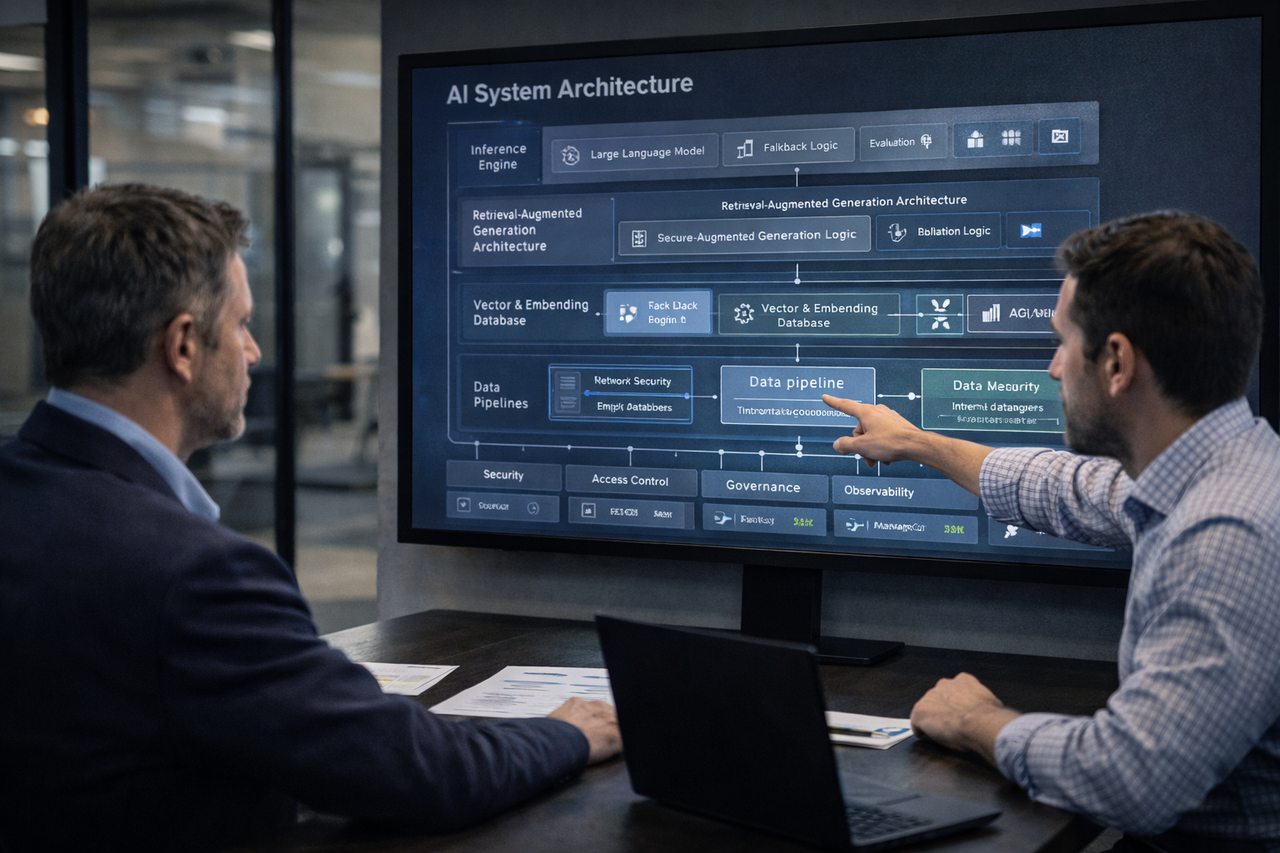
The simplicity of a prompt hides the complexity of production AI. Most AI pilots fail due to poor orchestration, governance gaps, and technical debt. This article explains why cheap AI becomes expensive and how structured engineering prevents failure.
The modern AI interface is intentionally simple. A blinking cursor. A text box. A prompt. A response.
This design simplicity has created a catastrophic business misconception. Many founders and executives assume that because interacting with AI feels simple, implementing AI at enterprise scale must also be simple.
This assumption is wrong.
The simplicity of a prompt is a user interface decision. It is not a reflection of the engineering, data architecture, governance frameworks, evaluation systems, and operational redesign required to make AI reliable inside a real organization.
Treating AI implementation as a “cheap experiment” is not a cost-saving strategy. It is a structured way to accumulate technical debt, regulatory risk, and operational fragility.
The one-prompt narrative is not just misleading. It is financially dangerous.
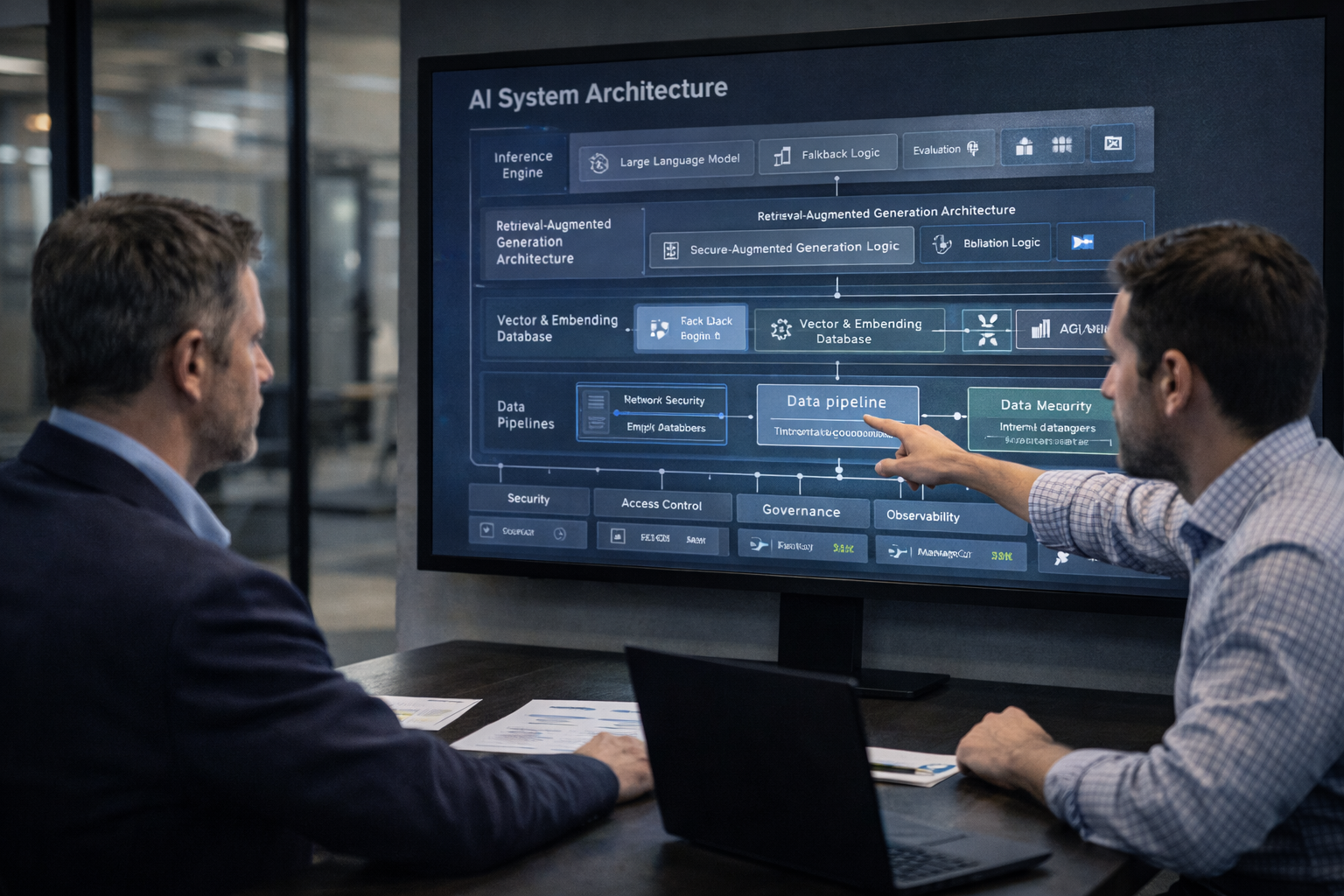
The defining AI challenge in 2026 is not model performance. It is orchestration and production reliability.
Research from leading institutions such as MIT Sloan has documented a severe gap between AI experimentation and measurable business impact. Most organizations run pilots. Few operationalize at scale. The failure rate of generative AI initiatives delivering sustained ROI remains extremely high.
The reason is structural.
A pilot is controlled. Clean data. Limited scope. Minimal compliance pressure. No integration complexity.
Production is hostile.
Production environments include:
Dirty data and inconsistent schemas
Legacy ERP and CRM systems
Fragmented data ownership
Regulatory exposure
Security controls
Latency constraints
Cross-functional dependencies
This is known as the Pilot-to-Production Gap. Gartner has repeatedly identified operationalization and governance as the primary barriers to AI value realization in enterprise environments.
The technology works. The orchestration fails.
When leaders ask for a “quick build” without discovery, they are effectively asking to bypass the very engineering required to survive production.
Dive in:MIT Sloan Management Review – Generative AI and Business Value
https://sloanreview.mit.edu
The “one-prompt” mindset assumes that:
If the model answers correctly in a demo, the system works.
If a chatbot produces coherent output, the business problem is solved.
If an API call returns data, the solution is production-ready.
This view ignores the fact that AI systems are probabilistic engines embedded inside deterministic business processes.
A production AI system requires:
Clear problem definition
Reliable data ingestion pipelines
Context management
Retrieval architecture
Security boundaries
Evaluation frameworks
Monitoring systems
Drift detection
Fallback logic
A prompt is not a system. It is an interface to a system.
The failure occurs when organizations confuse the two.
An AI system has visible and invisible layers.
The prompt
The UI
The demo
The conversational output
This is approximately ten percent of the engineering effort.
Data pipelines
Schema normalization
Vector indexing
Retrieval-Augmented Generation architecture
Embedding lifecycle management
Access control
Logging
Observability
Latency optimization
Evaluation harnesses
Model routing logic
Security hardening
This is approximately ninety percent of the engineering effort.
Refusing to budget for the submerged layer does not eliminate the work. It delays it. Deferred engineering becomes technical debt.
Technical debt in AI differs from traditional software debt. In conventional systems, debt may result in slower performance or brittle code. In AI systems, debt results in incorrect answers delivered with confidence.
This creates legal risk, brand damage, and operational breakdown.
Many organizations resist paying for discovery and structured roadmapping.
They ask for a quote without analysis.
This is equivalent to asking a structural engineer to quote a skyscraper without soil testing or architectural review.
In software engineering, a quote without discovery is a guess. A guess becomes a liability contract.
Discovery and scoping are not pre-sales overhead. They are risk mitigation mechanisms.
Without structured scoping:
Scope expands mid-implementation
Integration constraints surface late
Security architecture is retrofitted
Compliance gaps emerge
Budgets double
Timelines triple
The upfront cost of discovery is small relative to the cost of rebuilding an unstable system.
Small and mid-market businesses are particularly vulnerable to the one-prompt myth.
They often lack:
Dedicated data teams
Formal governance structures
Internal AI evaluation protocols
Security architecture maturity
When AI is implemented superficially inside an SMB, the following breakdowns occur:
Customer support bots provide inconsistent answers
Sales automation tools misinterpret CRM data
Internal copilots surface outdated documentation
Compliance boundaries are violated unintentionally
Instead of increasing efficiency, AI increases cognitive load. Employees begin double-checking AI outputs manually. Trust erodes. Adoption collapses.
A poorly implemented AI system creates operational drag.
A properly engineered system removes it.

AI systems in production environments are rarely isolated interfaces.
They interact with:
Airtable and operational databases
Salesforce and CRM layers
Slack and communication channels
ERP systems
Financial systems
Customer identity frameworks
An AI system that generates answers without deep integration into these systems remains ornamental.
True business transformation requires connecting intelligence to execution.
That means:
Permissioned access to systems
Transactional integrity
Error handling
Audit logs
Version control
Role-based access
Without these layers, AI remains an experiment.

Every AI deployment introduces three major categories of risk:
Data exposure risk
Operational reliability risk
Regulatory compliance risk
Generative systems also introduce model-specific risks:
Hallucination
Prompt injection
Data poisoning
Model drift
Context window limitations
Security researchers often describe a triad of risk conditions:
Access to private data
Exposure to untrusted content
Authority to act
When an AI system has all three without proper isolation, it becomes a high-risk automation engine.
Trade-offs must be evaluated carefully:
Speed versus governance
Cost versus reliability
Autonomy versus control
Flexibility versus compliance
Cheap AI prioritizes speed and cost.
Enterprise AI prioritizes reliability and governance.
The decision is strategic, not technical.
More info at: Gartner – AI in the Enterprise Research
https://www.gartner.com/en/topics/artificial-intelligence
A production-ready AI initiative requires phased rigor.
Define the business objective clearly.
Identify process bottlenecks.
Quantify inefficiencies.
Determine measurable outcomes.
If success cannot be defined, implementation should not begin.
Define the Minimum Level of Engagement.
Establish success metrics.
Design data flow architecture.
Identify integration points.
Scope discipline prevents uncontrolled expansion.
Build rapid prototypes.
Test assumptions cheaply.
Validate user workflows.
Evaluate outputs with structured benchmarks.
This is where experimentation belongs. Not in production.
Deploy retrieval systems.
Integrate vector search.
Establish monitoring frameworks.
Configure model routing.
Fine-tune models where appropriate.
Implement guardrails and access policies.
This is where engineering discipline replaces guesswork.
AI systems degrade over time.
Data changes.
User behavior shifts.
Business processes evolve.
External information updates.
Without continuous monitoring, evaluation, and retraining strategies, model accuracy declines.
This phenomenon is called model drift.
Organizations that treat AI as a one-time deployment ignore drift entirely.
Responsible AI deployment requires:
Ongoing evaluation
Feedback loops
Retraining pipelines
Performance dashboards
AI is not a feature. It is an evolving system.
The AI market is entering a maturity phase.
The competitive advantage will not come from access to models. Models are becoming commoditized.
The advantage will come from:
Superior orchestration
Robust governance
Operational integration
Data quality discipline
Engineering rigor
Organizations that master orchestration will scale. Organizations that chase prompts will stall.
In 2026 and beyond, AI literacy must expand from prompt engineering to systems engineering.
The winners will be those who respect the discipline.
Most pilots fail because they are not architected for integration, governance, and operational complexity. They demonstrate model capability but ignore production constraints such as data hygiene, security, compliance, and performance monitoring. When these realities surface, the cost of retrofitting becomes prohibitive.
Yes. Discovery clarifies business objectives, data readiness, integration complexity, and success metrics. Without discovery, implementation becomes guesswork. Guesswork in AI leads to scope expansion, hidden integration costs, and governance failures.
The largest hidden cost is orchestration. Connecting models to clean, structured, permissioned data while maintaining compliance and reliability requires significant engineering effort. The visible prompt interface hides the majority of this work.
In AI systems, technical debt manifests as incorrect or misleading outputs rather than slow code. Because generative models produce confident responses, errors can propagate into business processes unnoticed. This creates higher reputational and legal risk than traditional software debt.
A company is ready when it can define measurable objectives, allocate budget for engineering, commit to governance frameworks, and maintain continuous monitoring. AI readiness is organizational, not just technical.
AI is not a shortcut to business transformation.
It is an engineering discipline that intersects data architecture, security, governance, workflow design, and systems integration.
The one-prompt narrative reduces AI to an illusion of simplicity. That illusion collapses under real-world operational pressure.
Cheap AI is rarely cheap.
The true cost is paid later, in rework, instability, lost trust, and missed opportunity.
The organizations that win in 2026 will not be those who chased demos. They will be those who invested in architecture.
If you are evaluating AI initiatives inside your organization, start with structured discovery. Clarify the business objective, audit your data readiness, and define measurable outcomes before committing to implementation.
Book a 30-minute strategic discovery call here:
https://app.iclosed.io/e/singularagency/schedule-a-discovery-call
AI tools assisted in drafting, structuring, and reviewing this article. Final editorial judgment, analysis, and positioning were applied to ensure strategic accuracy and executive relevance.
Autonomous workflows allow AI to coordinate tasks, decisions, and actions across systems. This shift moves businesses from manual processes to intelligent, self-operating workflows.

Dashboards show what happened. AI operations systems decide and act on what should happen next. This shift is redefining how companies run their day to day operations.

LLMs are powerful, but prompts alone do not create business impact. Real value comes from embedding LLMs into workflows that connect data, decisions, and actions across systems.


