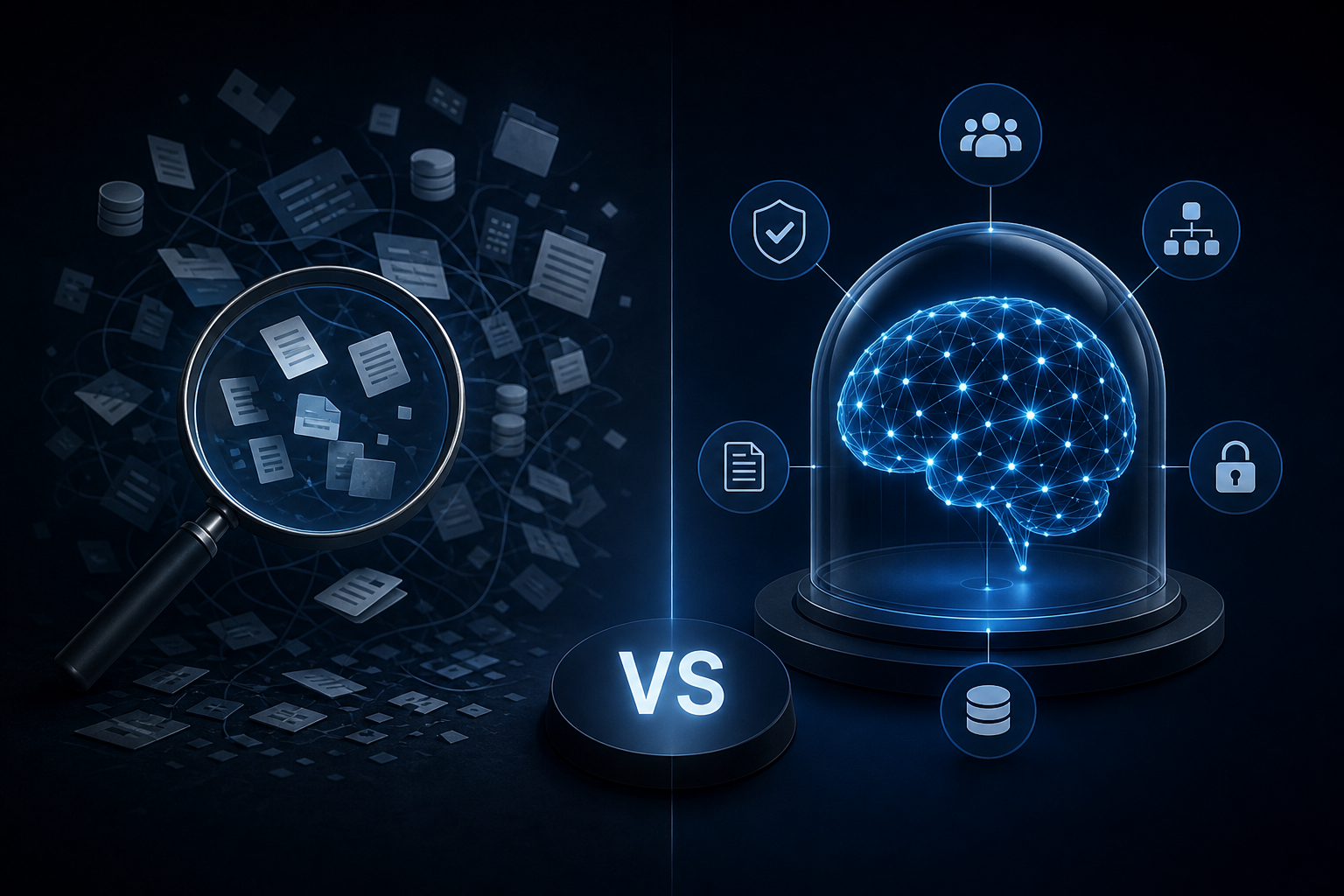
General
Enterprise AI Search vs. a Governed Company Brain: Key Differences
Discover how enterprise ai search differs from a governed company brain and which knowledge approach your team actually needs to act on trusted data.
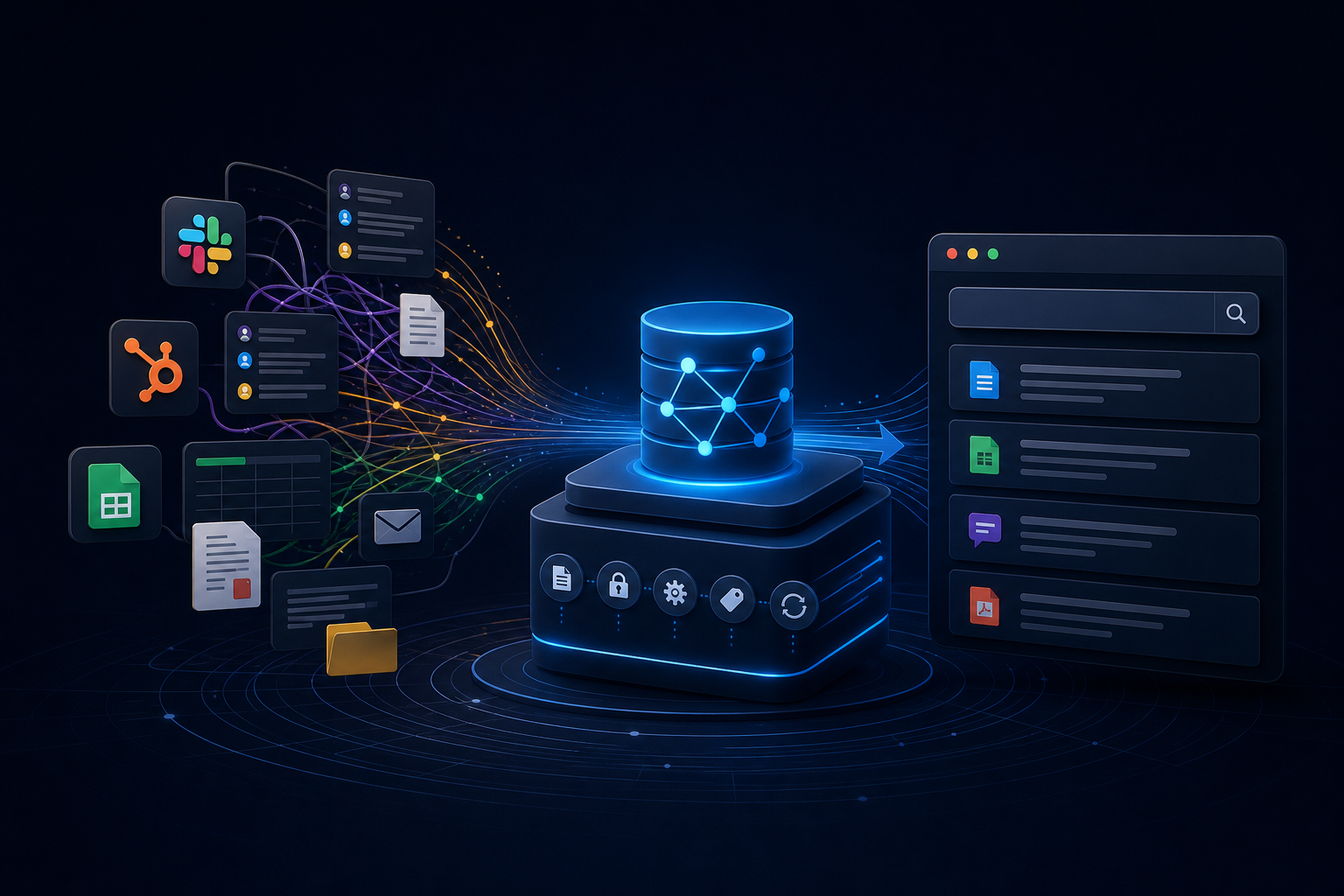
AI knowledge management done right means one searchable index across all your tools. Learn how to build the pipeline and governance to trust the answers.
Your ops lead just quit. She was the only person who knew which Airtable base had the current client pricing, which Slack channel held the vendor escalation thread from March, and which Google Sheet was the "real" one versus the three outdated copies sitting next to it. Now that knowledge is gone — or worse, scattered across six tools with no map.
That's the actual problem with AI knowledge management for most SMBs. It's not a technology gap. It's a structural one. Your business has knowledge everywhere and a single source of truth nowhere.
Here's what this article covers: what a proper AI knowledge management system looks like, how the indexing pipeline works end to end, and what governance you need before you can trust the answers it gives you.
Traditional knowledge management meant wikis, shared drives, and documentation that went stale the week after someone wrote it. People stopped using those systems because they were always out of date, hard to search, and completely disconnected from where real work happened.
AI knowledge management solves one specific thing differently: the system reads your actual working tools — Slack, HubSpot, Airtable, QuickBooks, Google Sheets, Microsoft Teams — and indexes them into a unified, searchable layer. You don't move your data. You don't build a new source of truth by hand. The AI builds the index from what already exists.
The architecture underneath this is called retrieval-augmented generation, or RAG. When someone asks a question, the system retrieves the most relevant content from your indexed sources and generates an answer grounded in that material. The quality of the answer depends entirely on the quality of the index.
Most companies at the $5M–$20M revenue stage run on a stack of tools that don't talk to each other. Decisions get made in Slack. Data lives in Airtable. Financial context sits in QuickBooks. Customer history is in HubSpot. Nobody has a complete picture because no single tool has complete data.
Knowledge fragmentation isn't just an enterprise problem. It's the default state for growing businesses that added tools as they scaled without ever building a connective layer between them.
The result: your team spends time searching instead of deciding. Any AI tools you've deployed give answers based on partial context. And when a key person leaves, institutional knowledge walks out with them.
Building a functional AI knowledge management system requires more than pointing a tool at your data. You need a deliberate pipeline with five distinct stages.
Before any indexing happens, map every system that holds business-relevant knowledge. That includes structured sources — Airtable bases, HubSpot records, QuickBooks reports — and unstructured ones like Slack channels, Google Docs, email threads, and meeting notes.
For each source, assign a named owner: a person responsible for its accuracy. This isn't optional. If no one owns a source, the AI will eventually surface stale or conflicting information, and you'll lose trust in the whole system.
Not every piece of information should be retrievable by every person. Payroll data, board materials, and individual performance records need role-based access controls before they enter the index.
This is permission-aware retrieval, and it has to be enforced at answer time — not just at the document level. A system that strips access from documents but assembles unrestricted answers from fragments is not actually governed. The access logic has to run at the moment the answer is generated.
Ingestion pulls content from your sources on a schedule. Chunking breaks that content into segments small enough for the retrieval model to compare against a query. Embedding converts those chunks into vector representations the system can search semantically, not just by keyword.
Chunking strategy matters more than most people expect. Chunks that are too large return imprecise results. Chunks that are too small lose context. Research published on arXiv found that recursive chunking with TF-IDF weighted metadata fusion reached an 82.5% hit rate at 10 in an enterprise retrieval setting — a meaningful benchmark for any team evaluating whether their indexing approach is actually working.
Raw chunks aren't enough. Each chunk should carry metadata: source system, document owner, last-modified date, department tag, and confidence tier. This metadata is what lets the system filter results by recency, flag stale content, and route low-confidence answers to a human review gate.
Without metadata enrichment, your index is a pile of text. With it, it's a governed data layer.
Knowledge goes stale. A pricing sheet from six months ago is worse than no pricing sheet if the AI treats it as current. You need automated freshness checks — scheduled re-ingestion, conflict detection when two sources contradict each other, and a clear process for deprecating outdated content.
This is the stage most DIY implementations skip. It's also why those systems degrade within months of launch.
A technically sound index with no governance produces answers your team won't act on. Governance is what converts a search tool into a system people actually rely on.
Four requirements matter most:
Ownership mapping. Every source in the index has a named human owner responsible for its accuracy.
Audit logs. Every query, retrieval, and answer is logged so you can trace what the AI said and why.
Review gates. For high-stakes answers — financial projections, legal documents, HR decisions — the system routes to a human before delivering the response.
Conflict resolution rules. When two sources disagree, the system follows a defined rule for which one wins. Not a coin flip.
A 2025 report from Frontiers in Artificial Intelligence examined 40 peer-reviewed publications on AI integration in knowledge management and identified data quality, employee resistance, and alignment with existing workflows as the main obstacles to adoption (Gelashvili-Luik et al., 2025). Governance is how you get ahead of all three.
Singular Innovation builds what it calls a Company Brain: a governed context layer that auto-indexes data from Slack, HubSpot, QuickBooks, Airtable, CRMs, ERP systems, Google Sheets, and Microsoft Teams into one searchable source of truth. Role-based permissions, audit logs, and retrieval scopes are built in from the start — not bolted on after the fact.
On top of that layer, Singular deploys HyperAgents: AI workers that run on a schedule to handle recurring tasks. Daily executive briefings, auto-generated dashboards, cross-tool task coordination — none of it requires someone to ask a question first. The system pushes the right information to the right person at the right time.
That's a different model than a reactive search tool. You don't query the Company Brain and wait. It surfaces what you need before you think to ask.
If you're thinking about how Airtable fits into this kind of architecture, Airtable as a Business Data Hub: How to Prepare It for AI Agent Access covers the preparation work required before connecting a base to an AI layer.
And if you want to understand what the build process looks like week by week, What to Expect When You Hire an AI Agency: A Week-by-Week Timeline walks through the full engagement structure.
Deploying an index isn't the finish line. You need measurement to know whether the system is actually changing how your team operates.
Four metrics worth tracking from day one:
Retrieval precision. What percentage of answers surface the most relevant source? Sample queries and score the results. Latency matters, but precision matters more.
Answer trust rate. How often does your team act on an AI-generated answer without manually verifying it? A low trust rate signals either poor retrieval quality or missing governance.
Source staleness rate. What percentage of indexed documents haven't been updated in more than 90 days? A high staleness rate predicts degrading answer quality before it shows up in complaints.
Query coverage. What percentage of questions your team asks return a confident answer versus a low-confidence fallback? Gaps in coverage tell you exactly which sources are missing from the index.
Pointing an AI chatbot at your Google Drive is not AI knowledge management. It's a search bar with a language model attached. The answers it gives are only as good as the most recently indexed document it can find — no governance, no freshness logic, no access control.
A real AI knowledge management system is infrastructure. It has owners, rules, schedules, and logs. It connects your actual working tools without replacing them. And it gets more accurate over time because someone is responsible for keeping it that way.
That's the distinction worth holding onto. You're not buying a feature. You're building a layer that makes every other tool in your stack smarter.
If you want to understand what ownership of that system looks like once it's built, How to Get Full Ownership of the AI Systems You Pay an Agency to Build covers exactly that.
The hardest part of building an AI knowledge management system isn't the technology. It's the audit: figuring out which tools hold real knowledge, who owns each one, and where the most expensive gaps are.
Singular's free 30-minute AI Audit maps your existing stack, identifies which sources are worth indexing first, and gives you a clear starting point — not a strategy deck. A first working capability ships in 10 business days from signed MSA.
Learn more at singular-innovation.com or book your free 30-minute AI Audit to get a specific answer about where your business should start.
What is AI knowledge management? AI knowledge management is the practice of connecting your business's existing tools and data sources into a unified, indexed layer that an AI system can search and retrieve from. Unlike traditional knowledge bases, it reads from live systems — Slack, HubSpot, Airtable, QuickBooks — rather than requiring manual documentation.
How is AI knowledge management different from a company wiki? A wiki requires humans to write and update content manually. An AI knowledge management system ingests content from the tools your team already uses, indexes it automatically, and keeps it current through scheduled re-ingestion. The knowledge stays live because it's pulled from working systems, not maintained separately.
What does "governed" mean in the context of a knowledge layer? A governed knowledge layer has defined owners for each data source, role-based access controls enforced at answer time, audit logs of every query and retrieval, and review gates for high-stakes answers. Governance is what makes the system trustworthy enough for your team to act on.
Do I need to replace my existing tools to build an AI knowledge management system? No. A properly built system connects to the tools you already use — Slack, Airtable, HubSpot, Google Sheets, Microsoft Teams — without replacing them. The AI layer sits on top of your existing stack, not instead of it.
How long does it take to deploy a working AI knowledge management system? For a defined first capability with a clear scope, Singular delivers a first working capability in 10 business days from signed MSA. A full organizational index takes longer, but the first working layer covers your highest-priority sources and is part of that first working capability in 10 business days from signed MSA.
What are the biggest reasons AI knowledge systems fail? The three most common failure points are: no ownership assigned to data sources (so content goes stale), no governance at answer time (so access rules get bypassed), and no freshness workflow (so the index degrades within months). Technical implementation is rarely the problem. Process and ownership are.
How do I know if my knowledge management system is actually working? Track four metrics: retrieval precision (are the right sources surfacing?), answer trust rate (is your team acting on AI answers?), source staleness rate (how much of the index is outdated?), and query coverage (what percentage of questions get confident answers?). These tell you more than any vendor dashboard.
Discover how enterprise ai search differs from a governed company brain and which knowledge approach your team actually needs to act on trusted data.
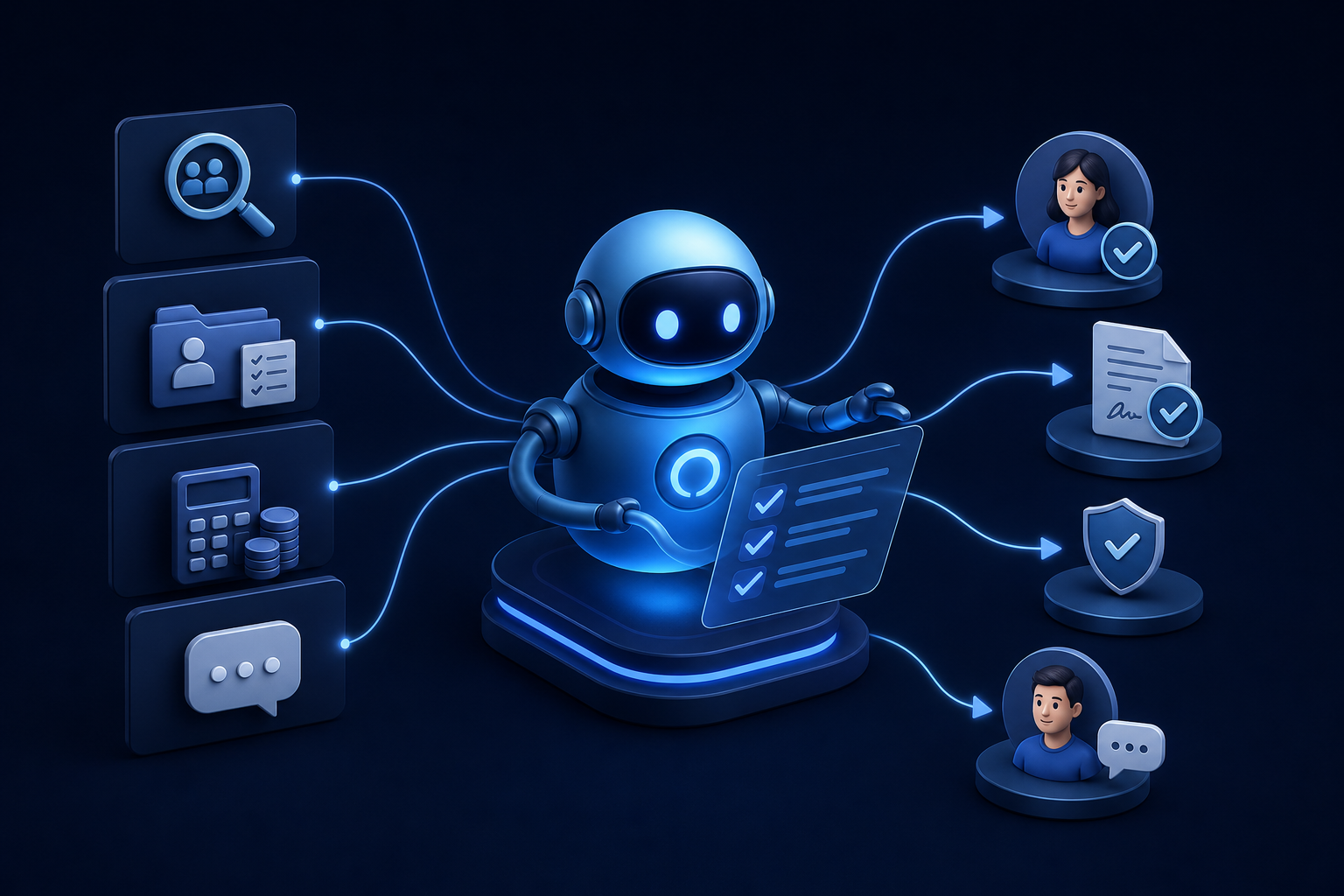
Discover how ai for hr automation handles recruiting, onboarding, payroll checks, and employee Q&A so your team can focus on work that matters.

Explore custom ai agent development paths: build in-house, buy pre-built, or partner with a specialist. Find the right fit for your team today.


